
Cryptocurrency Market Review (August 21st – 27th)

Cryptocurrency markets continued their upward march last week. While Bitcoin ended up falling agonisingly short of its all-time high on Friday (which was set during the previous week), the overall market capitalisation for all cryptocurrency markets set a new record of $158.5 billion. That constitutes an astonishing 795% growth rate in market cap for 2017. And while Bitcoin may not have set any new records during the last week, major altcoins Litecoin and Monero both managed set new highs respectively, thus underlining the broad interest investors are showing across the board in digital currencies.

That being said, Bitcoin continues to generate the most profound news of the week. After years of debate, drama and testing, Bitcoin’s scaling solution Segregated Witness (SegWit) finally went live on the network on Wednesday. Many have welcomed the upgrade, arguing that it will improve both Bitcoin scalability and security in processing transactions. According to Blockstack co-founder Ryan Shea, SegWit will lead to several specific enhancements such as the optimisation of signature hashing for linear scalability, a safer ecosystem for hardware wallets, enhanced upgradeability, and bandwidth reductions for nodes. Furthermore, the Lightning Network, which provides payment channels to move transactions off the blockchain and thus potentially boost Bitcoin’s capacity to millions of transactions per second, can finally be implemented by Bitcoin applications, now that SegWit is finally in place.

We have been acknowledging the truly global, “barrier-less” nature of blockchain in our market reviews, such as Papua New Guinea’s interest in the technology which we noted at the beginning of August. And it seems that PNG’s interest continues to grow with relish. Last week, the governor of the country’s central bank Loi M. Bakani led a seminar in demonstration of the country’s commitment to the technology, introducing the PNG Digital Commerce and Cryptocurrency Association, and discussing blockchain experimentation by the Bank of PNG. The central bank also discussed the results of recent research that hypothesises the potential creation of the “BitKina” – a new national cryptocurrency.
According to Ole Rummel, director of macroeconomic and monetary policy management at the South East Asian Central Banks Research and Training Center, a scenario whereby bitcoin and other cryptocurrencies will exist in tandem with a national cryptocurrency, such as the BitKina, and traditional fiat currency, could materialise in the future. This, according to Rummel, would allow the exchange rate between the Kina (PNG’s current fiat currency) and the BitKina to float freely against each other, which could be used as a monetary policy instrument tool by the central bank, alongside the potential to adopt negative interest rates if so required. This would increase the range of tools central banks have at their disposal to manage their respective economies.

And it’s not just PNG that recently revealed exploratory plans for a national cryptocurrency. On Wednesday, reports surfaced that the government of Estonia is seriously considering the integration of a nationally backed digital currency with its country-wide digital identification programme. Estonia has become somewhat of a global digital hub in recent years, and the proposal to create the nationally backed digital currency “EstCoin”. The government has now created a page on its website for the proposal, where interested parties can join a mailing list to receive the latest updates, read comments from Vitalik Buterin, and access the application form for Estonia’s blockchain-based e-Residency program.

According to Buterin, the co-founder of Ethereum, “If these Estcoins are issued on top of a blockchain, then it would become easy and convenient to use them inside of smart contracts and other applications.”

Indeed, it has been a busy time of late for Mr. Buterin. After we reported last week on some of the updates that he expects Ethereum to undergo imminently, Buterin met with the central bank of Thailand last week to discuss the possible integration of Ethereum and other cryptocurrency services such as OmiseGo with the country’s finance sector as a way to improve its existing banking systems and financial platforms. OmiseGo is an Ethereum-based technology that focuses on efficient payment processing and which has recently expanded its operations across Asia, Thailand included. According to the OmiseGo team, “Through the network connected to the Ethereum mainnet, anyone will be able to conduct financial transactions such as payments, remittances, payroll deposit, B2B commerce, supply-chain finance, loyalty programs, asset management and trading, and other on-demand services, in a completely decentralized and inexpensive way.” Thailand follows other countries in the region including South Korea, Japan and China to recently state its intentions to test possible applications of Ethereum to improve existing government infrastructures.

Another Asian country in the region, meanwhile, has also made significant and encouraging progress in its acceptance of cryptocurrencies. It was reported last week that Vietnam has approved a plan that could see the country formally recognise Bitcoin as a form of payment by next year. This news is especially significant as Vietnam held a notably conservative position regarding cryptocurrencies back in 2014. Today, that all seems to be changing for the better. Vietnamese Prime Minister Nguyễn Xuân Phúc has issued the country’s Ministry of Justice with a request to assess the existing legal framework for cryptocurrency, and report its findings by August 2018. The task will be coordinated along with the State Bank of Vietnam, Ministry of Information and Communications, Ministry of Public Security, Ministry of Industry and Trade, and Ministry of Finance. It is believed that the assessment will form the basis to create new proposals for legal standards and laws pertaining to virtual property and digital currency. officials are also expected to soon begin work on a tax treatment for cryptocurrencies.

And finally, in what was perhaps the most amusing story of the week, was the news that the famous fast-food chain Burger King announced that it is now offering its own cryptocurrency in Russia. Named after its flagship burger, the Whoppercoin recently launched on Russian blockchain platform Waves and customers can obtain the coin on a special digital wallet upon buying a whopper. One billion token will reportedly be issued in total, with a Russian Burger King spokesman stating that they will be used to pay for food at the restaurant as part of a new loyalty program. The news follows previous statements that Burger King in Russia would begin to accept Bitcoin at some point during the year in response to surging popularity of the digital currency. But it now appears that it has gone further and introduced its own coin – a clear sign that cryptocurrency could potentially be used for just about anything!



 

Token Sales (August 25th, 2017)

The token sale juggernaut continues, and although there were no records broken following the momentous Filecoin offering on which we reported last week, it was nonetheless an action-packed seven days. Take Decentraland as just one example; the Ethereum-powered virtual reality platform managed to raise an astonishing $24 million in just 35 seconds of its token sale campaign. In fact, it was so popular that many investors were left out in the cold, unable to acquire their tokens after the event quickly sold out.

Following swiftly on the back of the “SEC-compliant” Filecoin token sale, Tuesday saw blockchain-based developers of distributed applications BlockMason announce what is thought to be the first SEC-compliant public American token sale event for their product the Credit Protocol. This means that unlike the Filecoin token sale, which was only open to accredit investors, Blockmason’s Credit Protocol token offering will be open to the general public, which is a major leap forward in satisfying both investor inclusivity and regulatory compliance. The Credit Protocol enables the creation, tracking, and settling of debts on the blockchain. Its compliance with the SEC is ensured thanks to having already released numerous working products and distributed applications before this token sale. Furthermore, the token sale’s legal standing is further bolstered by the fact that Credit Protocol Tokens (CPT) are used for operating and using the Credit Protocol network, and not for investment purposes.

The SEC itself has also provided some more clarity on its view of token sales.

According to popular cryptocurrency website The Merkle, a new statement from the U.S. regulatory agency has clarified what it hopes to accomplish with regards to token sale regulation in the long run. It is reportedly concerned the most with mitigating the risks that emerge from such events, including fake pitches and hard sells. While this does not mean further regulation from the SEC is around the corner, it should provide some reassurance to investors who are considering whether to participate in a US-based token sale, that there is likely to be recourse from being the victim of a fraudulent event. That said, the SEC is also keen for investors to ask themselves whether there is a viable way for them to get their money back if required.

And it seems that some parties are already making the necessary changes in anticipation of further SEC regulation. Following the commission’s recent pronouncements on token sales, leading digital asset exchange ShapeShift announced last week that it will be reviewing the tokens that it currently supports on its platform. Indeed, ShapeShift believes that new definitions will emerge related to token as the technology continues to emerge and regulators apply more rules. As such, the start-up announced in an online post that it needs to make changes to ensure its service is not mischaracterised as a securities exchange, which in turn means that it is likely to “delist some types of tokens from the platform”. To determine what constitutes a security on the platform, it will adopt the “Howey Test” on all existing tokens and new tokens it lists in the future, which is the same test run by the SEC. Under the Howey Test, a transaction is classified as security if it’s an investment of money; there is an expectation of profit; the investment of money is a common enterprise; and the profit comes solely from the effort of the seller or third parties.

Arguably the most interesting token sale that is due to be launched – and which showcases the breadth of applications that can be potentially covered by blockchain – is a project called VOTES, a democratic voting platform. The idea behind the project is to use blockchain and smart contracts as the basis for transparency and tamper-resistance in the voting process, whether it be for national elections or for local polling. Indeed, even private companies that rely on voting data, such as marketing polls and surveys, could benefit. While the VOTES team also lists additional use cases including conducting exams at universities, shareholders voting, testing and questionnaire for employees and sociological surveys. Clearly such a mechanism would have immense societal benefits, particularly in countries/industries where corruption of the voting system is a serious problem. The VOTES pre-token sale event is now underway, and will remain open until the end of the month.
For those investors interested in participating in blockchain / token sale conferences, Stockholm’s Blockchain & Bitcoin Conference on September 7th will provide just such an event. The conference will be mainly focusing on the hot topic of token sales. The Smile-Expo company event, which has organised multiple blockchain conferences across Europe, will host some of the industry’s luminaries who will share their experiences of hosting successful token sale campaigns, as well as providing analysis regarding the future prospects of token sales.

Cryptocurrency Market Review (14th-20th August)

You would be forgiven for thinking that you’re experiencing a case of déjà vu, after last week’s market movements proved to be almost a repetition of the previous week’s events. Yet again, Bitcoin scaled new heights, hitting an all-time high of $4483 on Thursday. And yet again, the market cap for the entire cryptocurrency complex set a new record, in excess of $147.2 million. To provide some real-world context, moreover, Bitcoin’s market cap of around $70 billion puts it on par with S&P 500 stalwarts Netflix and PayPal.

But while Bitcoin continued rallying, last week was arguably more about the story of Bitcoin Cash (BCH), the new cryptocurrency that was created from the August 1st fork of Bitcoin. Having traded consistently around $300 during the first half of the week, BCH suddenly sprung into life on Thursday. Two days later, it was trading just shy of $1000. There is one main reason underlying this trend – as blocks on the BCH blockchain continue to be processed, the mining of such blocks is becoming more profitable. Reports suggest that as the price of BCH rose last week, miners apportioned more of their computing power to the BCH blockchain, rather than to Bitcoin. And after a specific block was mined over the weekend (block #479808), a trigger was induced that substantially reduced the difficulty of mining BCH blocks compared with those on the Bitcoin chain. BCH miners will thus earn significantly more by mining BCH than they would Bitcoin, and as they switch over to BCH, the increased processing power and lower transaction fees are likely to drive more investors to Bitcoin Cash.

And while it has been an eventful few weeks for Bitcoin and BCH, it has been a relatively more sedate period for Ethereum. Having dipped to a recent low of $150 in July, it has since recovered and remained stable around the $300 mark. But that didn’t stop Ethereum founder Vitalik Buterin from sharing his thoughts about his platform and cryptocurrencies in general last week. Buterin sees much of the value of cryptocurrency and blockchain for payments as not being within countries, but between them, “Crypto is really great for very easily and efficiently sending money across any borders in a standardised way, and Ethereum-style systems can extend that from just payments to more complex forms of applications and smart contracts”. And as for Ethereum, the founder expects to be making some significant improvements to the platform over the coming weeks. For instance, new programming languages are set to be introduced, such as Viper, Bamboo, and LLL, while the existing language Solidity will also undergo improvements. Hopefully such upgrades will allow for a greater range of decentralised applications to be able to run on the Ethereum platform.

Swiss lender Falcon Private Bank, meanwhile, announced on Thursday that it was extending its blockchain asset management services to enable its customers to access three new cryptocurrencies.

The bank garnered much attention last month when it became the world’s first bank to allow their clients to use their holdings to buy and hold Bitcoin within their Falcon portfolios. And now, the bank has expanded this service to include popular coins Litecoin, Ether, and Bitcoin Cash, largely in response to the positive feedback it has received to date far from customers using the Bitcoin service. Investors looking for an integrated and expanding cryptocurrency service from their bank, as well as the opportunity to diversify their holdings, would do well to review the offering available from Falcon, a bank that has a solid $14 billion of assets under its management.

It’s been a busy week for Australia as far as cryptocurrency regulation is concerned. On Thursday, it was revealed that the government will strengthen its anti-money laundering and counter-terrorism laws through a proposed amendment that will bring specific cryptocurrency regulation under the remit of Australian law. The proposal seeks to lay out a clear definition of what a digital currency constitutes, including a “a digital representation of value that functions as a medium of exchange, a store of economic value, or a unit of account; and is not issued by or under the authority of a government body”. It also provides tough rules for digital currency exchanges operating in Australia, including the mandate that they register with the Australian Transaction and Reports Analysis Centre (AUSTRAC), and that unregistered exchanges will be subject to harsh penalties, including imprisonment for 2 years for first time offenders, and 7 years for repeat offenders.
Such reforms are clearly welcome for keeping cryptocurrency markets free of financing of organized crime and terrorism, activities that they have unfortunately been associated with too closely over the last few years. The moves by Australia also follow similar measures taken by other countries. April saw Japan approve Bitcoin as a form of payment across the country, as well as implement strict regulations on Bitcoin exchanges in accordance with AML and Know Your Customer (KYC) requirements. China’s central bank, meanwhile, has investigated the operation of Bitcoin exchanges within the country, prompting exchanges to cease Bitcoin withdrawals and enhance their systems to remain in compliance with AML and KYC requirements. And member nations of the EU are also considering imposing new rules for Bitcoin exchanges within the region as part of its Fourth Anti-Money Laundering Directive.

But while regulation of Bitcoin exchanges grows in some countries, the first Bitcoin exchanges are taking off in others. Thursday saw the welcome news surface that Egypt will launch its first exchange, Bitcoin Egypt, in September. Although the exchange’s co-founder Rami Khalil stated that he is still “waiting on the Egyptian government to set some kind of regulations”, he was also convinced that “Cryptoassets are happening whether the Egyptian government joins in or not”, despite the lack of any regulatory framework in the country for cryptocurrency. The Egyptian pound has dropped dramatically in recent months – by over 50% since November – which makes Bitcoin Egypt an ideal solution for those looking to adopt digital currencies instead of having to rely on – and suffer from – exposure to government-backed fiat currency.

Satoshiland: Latin America is the Real Deal!

Latin America is the perfect place to show that Satoshi Nakamoto’s true vision is not a speculative game between a group of geeks and gamers who replaced the exchange of baseball cards with a handful of encrypted codes, but to have a totally electronic peer-to-peer version of money that allows you to make online payments directly from one site to another without having to go through a financial institution or government.

Latin America is a region that has been hit for decades by political and economic crises that do not seem to disappear in most of their countries. This has forced many Latin Americans to abandon their families and seek better opportunities in other latitudes, since there is no improvement in the essential aspects of having a decent quality of life in their own country.

GDP growth in Latin America returned to negative in 2016 for the second consecutive year, between -0.5% and -1.0%. The region had not experienced a two years economic contraction since the 80’s. This poses challenges for the protection and implementation of socio-economic progress, in particular to reduce poverty, increase freedom and expand the middle class. Thus, about 7 million Latin Americans fell into poverty in 2015, bringing the total number of poor to 175 million people, 29% of the population; More than 250 million unbanked adults and between 25 million and 30 million vulnerable Latin Americans – one in three of those who emerged from poverty in the last decade – could fall back into it if the deceleration continues and they lose their employment, or if they become ill or if they decide to retire.

Economic projections confirm the heterogeneity that characterizes the region, with very different rates of growth expected between countries. Mexico, Central America and the Caribbean have a more hopeful outlook, due to the close bonds they have with the US economy. The challenge will be bigger for those countries with a less stable macroeconomic picture, like South American countries, just because the 2017 economic scenario for them was very low.

With political instability in some of the largest economies in the region, as well as a general fall in oil and other commodity prices, businesses and consumers face a depression and, in the case of Venezuela, an economic collapse.

BITCOINZUELA
Satoshi is doing for Venezuela´s economy what their President Maduro does not do. In a country where the government strives to avoid economic and social stability to stay in power through repression, Cryptocurrency as Bitcoin is already providing protection against hyperinflation and access to consumption of financial services that allow their citizens to continue with their daily life in the middle of the worse economic circumstances of its history.
While the Venezuelan currency continues to crumble, the country’s population is finding an unprecedented opportunity to use the Cryptocurrency to restructure its economy without having to wait for the government to “fulfill its job”. While the regulation of cryptocurrencies as a currency or free and decentralized payment method may continue to be far away, the banking crisis and economic mismanagement have eroded citizens’ confidence in their governments and banks, accelerating the adoption of Bitcoin as the the best alternative to escape from so many injustices, abuses and corruption on the part of its rulers.

WESTERN BREAK
This sociopolitical situation has forced many Latin Americans to migrate to countries where they get better living conditions and job opportunities that allow them to generate higher incomes. This migratory movement that has been increasing in the last years, has also generated an increase in the shipment of remittances; Large numbers of migrants sending money to their families to survive the economic crisis; For the second year in a row, remittances flows to the Latin American and Caribbean region (alc) surpassed their historical values, reaching US $ 65,657 million in 2016, with a growth rate with respect to the previous year of 5.9 %, The highest recorded in the last four years. While companies such as Western Union and MoneyGram celebrates this growth by charging up to 25% to move all that money, users are starting to discover alternatives like Bitcoin, which allow them to save up to 80% of time and money…

We all know how difficult it is for to send money outside of our borders through these remittance services or the delay of an international bank transfer and, in the case of Ecuador, an extra 5% tax to send capital abroad.

Can you imagine what will happen when all the people of Latin America find out that all that money they spend on taxes and bank charges can remain in their pockets?

When an effective solution meets a general need, it is inevitable that a massively positive reaction explodes becomes obvious. In the case of Latin America, the migrants are the first to catch the cryptocurrency fever, because they promote the use of Bitcoin and other cryptocurrencies with their families to bring more money home. This has generated a replacement of Western Union´s services… A very similar process like the telecommunication companies went through when WhatsApp came along: People prefer free services.

THE CURE IS GROWING
There are impressive growths for the massive adoption of Cryptocurrencies in Latin America. While the rest of the world speculates and plays to make money with the growth of the coin market capitalization and ICO fever, in Venezuela, Argentina, Colombia, Brazil, Mexico and the rest of Latin America, real economic problems are being solved with The antidote that Satoshi Nakamoto donated to all of us.

Data released last year by the BitPay payment processor suggest that Bitcoin’s faster adoption is taking place in Latin America. Revealing a 510% increase in Bitcoin transactions between 2014-2015, compared to an increase of only 70% in Europe.

In July 2017, BTC’s trade in Venezuela for the first time exceeded USD 1.5 million in operations recorded during a single week, on the LocalBitcoin.com platform. The 50% jump reported in less than six weeks, from the previous record, seems driven by the need of many Venezuelans to access, through different mechanisms, foreign currency or exchangeable securities with which they can protect their patrimony in the face of the devastating local currency devaluation. The dollar price in Venezuela reflected a rapid contraction of more than 50%. This rise in the dollar value that came to unprecedented levels at the end of July could generate a psychological effect that has driven the purchase of bitcoins as a mechanism of protection value, reaching a total sale of 425 BTC. However, it has not been the month that has had the most demand for the pioneer coin Bitcoin, by April 2017 Venezuela registered a volume of 736 bitcoins through LocalBitcoin.

Venezuela continues to be a relevant market within the region, which increases the volume of BTC transactions every day. Currently, demand in Brazil is experiencing a significant contraction since the highs records registered in May, while operations registered in Argentina are better in line with its level.

Chile, on the other hand, shows an increasing adoption curve with slight setbacks in recent weeks. Likewise, countries like Colombia, Dominican Republic, Mexico and Peru also tend to a sustainable scenario and with growth potential in the Cryptocurrencies demand.

Everything indicates that the popularity and growth of the Cryptocurrencies use in Latin America is a reflection of the population´s needs which relates on the fact that they have to be able to regain control of their own money. It is in these latitudes that the great global solution to the bank fraud can be Crypto-currency. It is here that you can see that this financial revolution is real, not a trend caused by “many geeks playing Monopoly with video game money”, Blockchain is changing the world and Latin America seems to be the perfect breeding ground for them to take out all the experiments and entrepreneurship initiatives that shows that the main cause of social ills do not come from an economic crisis – because there is more than enough money – but from the lack of financial education that teaches us to know how to redistribute it, eliminating the restricted access to the financial system to people who need it the most.

Cryptocurrencies came to break these obstacles, but it is important to incorporate instruction, information and education on how the banking system works and why we need to ride the wave of money E-volution urgently. Just as it did with the communications and information industry, the Digital Era is transforming the financial sector, reinventing it into a more fair, democratic and transparent way.

The Internet is breaking all the paradigms and, without asking permission to the Status Quo, it is leading us towards a freer, efficient and more decentralized world.


 

by Janko Ranghi | @Cripto_Jankoin | Ecuador

Cryptocurrency Market Review (July 31st – August 6th)

A week of sheer exhilaration in the cryptocurrency world has just been and gone, one which served up a veritable feast of opportunities for investors. The Bitcoin split took place as expected on August 1st; the new Bitcoin Cash almost immediately made its presence felt by rallying by about 250% over the next 24 hours and briefly attaining a top 3 position on the cryptocurrency market capitalisation leader board; and both the Bitcoin price and the overall market cap of all cryptocurrencies recently touched new all-time highs. And that’s not forgetting to mention the stellar returns that have transpired for altcoins virtually across the board. Clearly, it has been a week to savour.


Moreover, it still seems like it may well be just the beginning. There appears to be a growing chorus of bullish forecasts for cryptocurrencies over the next few years. We previously mentioned Goldman Sachs’ view of Bitcoin hitting $4000, for instance. And then there are some predictions that are perhaps excessively enthusiastic, such as a recent one from cybersecurity pioneer John McAfee of Bitcoin at $500,000! But the projections made by founder of Standpoint Research Ronnie Moas – that Bitcoin will surge to $5000 in 2018 – is certainly worthy of note. As part of his in-depth 122-page report on cryptocurrency, Moas also expects Ethereum to hit $400 within the next year, and Litecoin to double to $80. Moas is among the world’s leading independent market analysts, and as per his report, he is fully confident that “1% of the money in cash, bonds, stocks and gold [which is valued at $200 trillion in total] will end up in cryptocurrencies”, which will in turn drive much of the predicted price gains over the coming months.

Indeed, it is financial markets that have perhaps had the most eventful week of all, as far as cryptocurrency and blockchain is concerned. After we highlighted last week the progress made by the CFTC to allow digital currency platform LedgerX to provide clearing services for fully-collateralised digital currency swaps, it is now the turn of the Chicago Board Options Exchange (CBOE) which has reportedly partnered with bitcoin exchange Gemini to launch cryptocurrency derivatives trading. According to reports, the venture will allow CBOE to use Gemini’s Bitcoin market data in order to launch a dedicated product listing later this year, although the exchange is still waiting for the green light from regulators. If approval is obtained, it would allow institutional investors the opportunity to hedge against the pronounced price swings being witnessed in most cryptocurrency markets. Plans are reportedly being put in place to launch cash-settled bitcoin futures by the fourth quarter, again pending regulatory approval.

It has also been an eventful week for Nasdaq. In the last week, it was revealed by the U.S. Patent and Trademark Office that the world’s second biggest exchange wants to patent a system for securely distributing time-sensitive information via a blockchain. Such information would ostensibly be transmitted and timestamped; and if it needed to be submitted to an authority, edits could be made before being shared with a third party for approval, with each update being recorded on the blockchain to maintain its security. Nasdaq also recently signed a deal with SIX Swiss Exchange, the operator of Switzerland’s primary stock exchange, to integrate blockchain into its over-the-counter (OTC) product services.

Nasdaq has been one the leading lights within the finance industry in pushing for greater blockchain adoption. For instance, it created Nasdaq Linq back in 2015 which enabled private companies to digitally represent their share ownership using blockchain. And then more recently, it joined with Citigroup to create a new integrated payment solution that uses blockchain to record and transmit payment instructions.
What’s more, Nasdaq is not the only major exchange that is enthused by blockchain technology. On Tuesday, the Hong Kong Stock Exchange (HKEX) announced that it is planning to launch a separate blockchain-powered market called the HKEX Private Market, aimed at serving companies in their early stages to obtain financing before they are ready to enter public markets. According to HKEX CEO Charles Li, such firms will be able use the Private Market to conduct “pre-IPO financing and other activities on an off-exchange venue not under the regulatory remit of the Securities and Futures Ordinance.”
Elsewhere within the financial services universe, it was revealed on Monday that one of the world’s biggest banking institutions, the Bank of America, has filed three new patents related to applications of distributed ledger technology, and in particular, its role in validating the integrity of information. It seems clear from the filings that the bank wants to use blockchain to validate both the digital identities of its systems’ users and the information within those systems. One of the patents, for example, relates to using blockchain to track and validate user identification, such as updating information pertaining to a new user’s identification, with new details such as signatures and locations being stored and timestamped as time progresses. And another patent relates to how the technology would be used to validate changes to user identity, and thus how the system would update over time.

Blockchain seems to be progressing towards mainstream acceptance at a notably brisk rate. On Monday, a study by independent research firm Juniper Research was released which found that 57% of large corporations – that is, those with more than 20,000 employees – are either currently or will be developing strategies using blockchain technology. According to the surveys conducted by Juniper, which involved approximately 400 executives at such organisations, 66% of companies expect to integrate blockchain by 2018’s final quarter. The research also indicated that those firms in particular need of transparency, such as those that are heavily dependent on paper systems or those that execute a high volume of transactions, would ideally be positioned to benefit from blockchain technology.

As such, it seems apparent that an increasing number of entities are now eager to pursue blockchain research in the hope of uncovering solutions that improve costs, efficiency and security. And this can only be positive for cryptocurrency markets – as the world becomes more familiar with blockchain, it only stands to reason that it will gain a clearer understanding of how this technology is powering the ongoing cryptocurrency revolution.

Exclusively for Crypto World Journal


Token Sales…

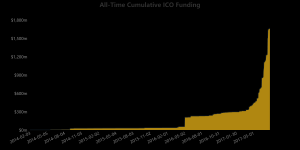
The sheer scale of token scale activity continues to expand, seemingly unabated. To get some sense of just how fast this space is growing, popular cryptocurrency website CoinDesk analysed data from 2014 through July 2017 and found that blockchain start-ups have managed to raise a total of $1.67 billion via token sales; most astonishingly, however, was that $1.38 billion of this total was raised in 2017 alone, and thus represents over 600% growth year-on-year.

And that growth rate looks set to continue accelerating, especially given that July has raised over $540 million, which makes it the best month on record, as well as the third consecutive month in which a new record has been set. Although blockchain companies have raised slightly more through venture capital firms during this period (nearly $1.8 billion), at current growth rates the amount raised from token sales will overtake the amount raised from venture capital by the end of this month. Indeed, blockchain projects raised nearly $800 million through token sales in the second quarter, which comprehensively outshines the $241.3 million provided by venture capital firms.
Is there anything that can slow this growth down? Possibly. We saw last week a major development take place when the US Securities & Exchange Commission (SEC) decided to rule that DAO tokens constitute a “security” and should be regulated under existing securities law. This may make some token issuers think again about hosting token sale events in the US, or about dealing with US citizens. That being said, there appears to be no sense of token sale activity cooling down thus far. On the contrary, there are about 120 upcoming or active token distribution events currently in the diary for 2017, and importantly, about 20 have been announced since the SEC’s decision. This would suggest that, there appears to be little stopping blockchain firms from creating new token events.
Perhaps more token sales in the future will simply follow the example of Filecoin, which last week raised $52 million in a pre-sale offering. Filecoin claims to be an SEC compliant token sale, and has an extensive list of supportive documents for regulatory authorities to investigate if required, including its white paper and a “Private Placement Memorandum to Simple Agreement for Future Tokens”. Filecoin’s tokens will also only be sold to accredited investors, such as investment firms, banks, and high net worth individuals, while each investor is required to complete a questionnaire in order to participate in the token sale. Of course, such an arrangement prevents the majority of regular cryptocurrency investors from taking part, which goes against the spirit of token sales and their typically inclusive nature to date. Nevertheless, solutions will hopefully continue to be sought that enables regulatory compliance and allows for a diversity of funding sources.

It should also be mentioned that it is not only the US which has recently sought to provide clarification on token regulation. Last week, the Monetary Authority of Singapore provided its own views on token sales, and comes in the wake of recent growth in the number of token sales in Singapore. Indeed, with the likes of with the likes of TenX, Golem and Qtum having hosted some of the world’s biggest offerings to date in the country, it has managed to gain a reputation for being a hotspot for token sales. As such, the MAS has looked more closely into the space, and has decided that the offer or issue of digital tokens in Singapore will be regulated by MAS if the digital tokens constitute products regulated under the Securities and Futures Act (SFA). Much like the SEC, therefore, it seems that it would regulate some token sales, but not necessarily all. The main takeaway point seems to be that any entity considering an ICO involving Singapore in some capacity should seek independent legal advice to ensure they comply with all applicable laws, and consult MAS where appropriate. Again, this should be perceived as a positive development, as it provides rules and legitimacy to token offerings, something that will enable more risk-averse investors to participate in the space.

There is also likely to be significant development in the way token sales can be assessed for their legitimacy, which in itself will provide greater protection for investors, irrespective of regulations that may or may not be implemented. Indeed, the “ICO Transparency Monitor” was launched last week by Neufund, a Blockchain-based and investor-directed platform that aims to bridges the Blockchain and venture capital worlds. The Monitor is described as a powerful toolkit, one that evaluates token sales and other token events by assessing specific metrics of the offering, such as the past, present and future fundraising actions of the issuing company. The calculated scores will then allow investors to make more well-informed judgements over whether a specific token sale should be classed as “transparent”, “transparent with issues”, or “non-transparent”. Clearly if such a project operates successfully as described, it will remove some of the transparency issues that give rise to investor apprehension.

One particular token sale event announcement during the week caught the eye. It was revealed on Thursday that John Mack, the former CEO of US banking giant Morgan Stanley, will be taking the plunge into token sales by soon launching his own offering. This marks another major scoop for the cryptocurrency world, as it manages to convince yet another heavyweight name from the investment banking world to take the leap. Mack’s project is Omega One, which is described as being “the bridge between traditional capital markets and the crypto markets” – the idea being to offer cryptocurrency investments to potential customers in a similar manner to that of traditional assets. Mack has been highly effusive is his praise of cryptocurrencies,

“I have been watching and investing in the cryptocurrency market over the last several years, and I find Omega One to be an important next step in the emergence of this new economy”

were his recent thoughts. According to recent reports, moreover, Mack is aiming to raise a whopping $950 million from the token sale which, if true, would dwarf anything that has come before it.