
Kyocera, a Solar Power Supplier, Join Forces with LO3 to Improve the Distribution of Energy

Over the last few months, prominent companies that perform their activities in the energy supply department have successfully experimented with blockchain. It is, in fact, one of the fields with the highest improvement potential thanks to the technology that is, slowly but surely, changing the world step by step.

The latest company to test the blockchain technology for its potential to streamline and optimize processes is Kyocera, a very widely known solar power supplier based in Japan. The firm has established a partnership with LO3 Energy with the intention of trying blockchain-based virtual power plants (VPP) that hold the potential of improving the distribution of energy.

The Promotion of a Low-Carbon Society

The information was made public via a press release by Kyocera, on Monday, February 25 th. The test is scheduled for February 28th, and will server as a foundation for both firms to establish the feasibility of VPPs. The idea, as a whole, is to promote a low-carbon society that functions without a clear need of fuel o carbon emissions, and that is based on a peer to peer (P2P) distributed consensus network.

“Kyocera is committed to developing low-carbon solutions that maximize renewable energy resources,” were the words of Hironao Kudo, Deputy General Manager of Kyocera Corporation’s Corporate R&D Group. “We are excited to be the company in the area of grid management in Japan to collaborate with LO3 Energy, which has consistently proven its blockchain technologies all around the world.”

With the help of LO3 Energy, Kyocera intends to set up small VPPs using its solar photovoltaic (PV) modules and batteries. The other firm, based in New York, will have the responsibility of managing the flow of energy, and will do it with the use of the distributed ledger technology.

Blockchain Technology to Verify and Record Transactions

Why is the blockchain technology necessary for the success of the joint project? LO3 Energy will apply the model to verify and record transactions. Therefore, it will distribute energy with its own solar panels by implementing a microgrid, instead of the more traditional large grids.

Kyocera is an influential company in the industry with proven financial success, having made 81.79 billion yen ($736 million) in net income. The firm is a market leader in Japan, and specializes in the production and development of solar power generating systems and storage batteries for the VPP test projects, led by the country’s governmental authorities. Lately, Kyocera has been improving in remotely controlled distributed power systems.

Lawrence Orsini, who currently acts as the CEO of LO3 Energy, observed that “the need to reduce carbon emissions is exerting a profound impact on energy providers worldwide. Using distributed ledger technologies, our networks enable the micro energy transactions needed to meet this challenge. We believe the synergies between Kyocera and LO3 Energy will produce a new generation of virtual power plants that can accelerate Japan’s transition to a low-carbon society.”

The project can potentially change the way energy is managed and produced, thanks to the implementation of the blockchain technology.

It is not the first alliance to gain grounds in the quest to find a more efficient use of energy. The international tech giant IBM established a partnership with blockchain company Veridium Labs in May 2018, with the primary objective of tokenizing carbon credits that would let businesses to track their carbon footprint thanks to the blockchain technology.

By Andres Chavez

Argentina and Paraguay Export for the First Time Merchandise Using Bitcoins

Bitex was the intermediary company for this micro export to be conducted  instantaneously paying with bitcoins

Argentina and Paraguay celebrated the first export of goods which went through customs and used bitcoins (BTC) as a means to conduct the operation almost instantly. The news was announced on Thursday, February 14th, through different web portals in Latin America.

The blockchain solutions company Bitex, which has a bitcoin platform to conduct its commercial operations, was in charge of fulfilling the commercial transaction between both countries. The central idea was to use the company’s blockchain platform with the purpose that the money was settled within one hour, instead of using the regular payment channels that can take between two and three business days.

Marcelo Moscatelli, Bitex’s Director of Marketing, mentioned that this is a great advantage in order that this type of export operations, relatively small, can be conducted almost instantaneously and without complications. Moscatelli explains that the company only worked as a mediator, and that the payment was made in the official currencies of each country. “The service is always quoted in local currency, in this case, Bitcoin is only a vehicle to process the payment, the exporter receives Argentine pesos, or dollars, and the buyer pays in local currency”, he said.

When the purchase was made, it was known that the export was made from Argentina to Paraguay, so the payment was made in Guaranies. Bitex converted it to Bitcoin (BTC) and then changed it to Argentine pesos. The exported products, which carried out the normal shipping route through customs, were equipment and supplements for fumigation and pest control for a company dedicated to that service. It is estimated that the products are valued at $ 7,100.

It is important to highlight that for this operation, no dollars or any other conventional means of payment were used. The transaction materialized without using companies or organizations in charge of making payments through financial institutions or banks.

Manuel Beaudroit, Director of Bitex, stressed that these types of operations represent an advance for his company and that they start from a clear concept: his vision of developing the Latin American economies, as well as giving greater competitiveness and commercial presence to cryptocurrencies in conventional markets.

Support Channels for Export Success

Manuel Beaudroit revealed that for the success of this commercial transaction between countries, the help of a suitable platform was needed in order to allow clients to export goods at low costs. “We are part of the Export Simple program, which facilitates the export of goods and services below US $ 15,000. In this way, we facilitate international payments”, said Beaudroit.

This platform is a substantial support which enables channels for the export of goods anywhere in the world. These shipments must not exceed 300 kilograms and facilitate their access to the service without the need to invest large sums of money, paperwork or personal records as exporters.

By: María Victoria Rodríguez

Ukraine’s Embassy of Bitcoin is Illegally Dismantled

According to the Embassy of Bitcoin website, the Bitcoin Embassy in Ukraine building was dismantled and destroyed last week, on February 12th. The building was located in Kyiv, the country’s capital city, precisely in the Lvivska square.

Purportedly, workers of a communal enterprise dismantled a building in which a bookstore and the “Bitcoin Embassy in Ukraine” were based. Reports from the scene did not mention any conflicts in the zone nearby.

Informator reported that employees of the Department of Urban Improvement of Kyiv dismantled the Bitcoin Embassy in Ukraine, which is recognized as a small architectural form (MAF).

Properly Registered

Ukraine’s Bitcoin Embassy was properly registered as a non-residential building under the number 906987180000 on the right of private ownership of the Ukraine citizens, on the basis of the decision on state registration of rights and their encumbrance’s No. 29342816.

The indicated information is confirmed by the Information Reference from the State Register of Real Property Rights and the Register of Property Rights to Real Estate, the State Register of Mortgages, and the Unified Register of Exclusions of Real Estate Assets with respect to Real Estate Objects, under No. 57803370.

The building is protected by the Constitution of Ukraine, as well as the Civil Code, since it is a full-fledged property. According to Ukraine’s current legislations, “the demolition of immovable property in the event of the existence of appropriate grounds is conducted solely on the basis of a court decision.” In particular, in accordance with Article 41 of the Constitution of Ukraine, the right of private property shall be acquired in the manner prescribed by law.

The organization known by the name of “Bitcoin Embassy in Ukraine” was launched by the founder and CEO of the Kuna cryptocurrency exchange, Mikhail Chobanyan five years ago, in 2014, with educational purposes.

Respect to Private Property

Elemental law states that forced alienation of objects of the right of private property can be applied only as an exception to the motives of public necessity, on the basis and in the manner prescribed by law, and subject to the prior and full reimbursement of their value. Forced alienation of such objects with subsequent full reimbursement of their value is allowed only in conditions of martial law or state of emergency, with confiscation being only an option if a court decides so.

The dismantling of Ukraine’s Bitcoin Embassy is not condoned by the Ukrainian law under any circumstances. The Civil Code’s Article 321 states that property rights are inviolable. No one shall be unlawfully deprived of this right or limited in its exercise, only in cases that the law establishes.

Therefore, authorized people of the Kyivblaugustriy communal enterprise acted against Ukraine’s law. A police crew and investigation and operational groups were called. As a result, criminal proceedings have begun in the case of abuse of official position (Article 364 of the Criminal Code of Ukraine) by officials The Kyiv City Council (Kyiv city state administration) and the Department of Urban Improvement, under No. 12019100100001396 of 12.02.2019. The owner of the real estate object – was involved as a victim to these criminal proceedings. A similar scenario took place on February 13th, and the police once again showed up in the spot to restore order and protect the rights of the property’s owner.

“We believe that the actions of authorized persons of the Department of Municipal improvements of the Kyiv City Council (Kyiv City State Administration) and utility “Kyyivblahoustriy” of the Kyiv City Council (Kyiv City State Administration) on dismantling the property at Kyiv, Lviv square 1, are inadmissible and illegal because they violate the right guaranteed by the Constitution of Ukraine to the inviolability of private property and the requirements of the current legislation of Ukraine regarding the possibility of demolition of the property only by a court decision,” was the official statement of Ukraine’s Embassy of Bitcoin.

By Andres Chavez

Ghatto, the First Motorcycle to Use Blockchain Technology in Spain

About 50 scooters will be manufactured per day, according to what researchers and project developers said

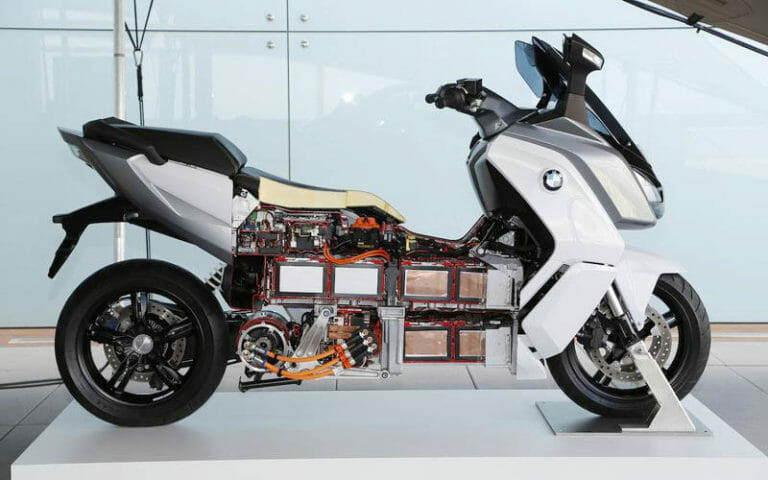
Researchers from the Polytechnic University of Valencia, in Spain, developed an electric scooter motorcycle that will have an integrated blockchain system.

According to a press report, which gives more information about the creation, it was informed that the blockchain system the moto will use would be specifically for the measurement of data, such as the storage and coding of relevant information about the use of the motorcycle.

The mileage, the places where the motorcycle has been, the revisions it has had, the repairs, the conditions of its different parts, and even the times in which it has suffered a fall are some of the data that blockchain will use.

The objective is that the information remains unalterable, reliable and safe. “We want that for the sale of a second hand. In this way, it is not necessary to see the motorcycle. All the measurable of the motorcycle cannot be corrupted by the own definition of blockchain, which makes the data immutable”, concluded José Campillo, researcher of the Polytechnic University of Valencia.

The creators of the motor scooter, researchers José Campillo and José Soriano, have explained that their creation will compete perfectly with the T-max of the company Yamaha, or C-Evolution of BMW. They say that the motorcycle will not only demonstrate power, speed, and versatility, but also, its design will revolutionize the ideal concept of a motorcycle sport scooter, with a better price than its competitors.

“The electric motorcycle will compete with other models in its segment such as the BMW C-Evolution, although it will offer twice the power and autonomy for less than 15,000 euros, the price of the German manufacturer’s scooter”, said Campillo, before mentioning that the price of this motor scooter will be around 13,500 euros, an average of about 15,200 US dollars.

About the manufacture of the motorcycle, the researchers did not hesitate to mention that the manufacture and incorporation of the battery that will be used was the biggest challenge they had to overcome. However, they said this aspect is solved and that the motorcycle will have properly 70 kilos of lithium battery, exclusively imported from South Korea.

“We want the looks to go to the batteries when turning on the motorcycle, guided by low-intensity LEDs”, said Campillo. Among other technical details of the motor scooter, it was mentioned that it has a USB port for mobile, in addition to an LED screen to show the values ​​of the speedometer and for the guidelines, a special starting system that does not require keys and an integrated charging system that will allow recharging the battery with a fast type 2 power outlet, which ensures a full charge in the shortest possible time.

Regarding the special performance and speed characteristics of the Ghatto G1, it was developed with an aerodynamic design that will facilitate the passage of wind at high speed, as well as it will have a cell pack of 14.4 kWh, which will allow about 300 kilometers of autonomy, and reaching 100Km per hour in just 3 seconds.

The latest information about this new electric scooter motorcycle will be revealed next February 20th, when a special event will be held to announce it officially, in the port of Valencia, Spain.

By María Victoria Rodríguez

“Only Criminals Will Use Fiat in Five Years”, According to Tim Draper

Between late 2017 and early 2018, the vast majority of the industry was talking about how Bitcoin and cryptocurrencies would rule the world. However, skeptics took over from late February 2018 to this point; this is, during the long bearish market that has seen the planet’s most widely-known coin going from almost $20,000 to below $3,300. The debate is of course, still open.

The latest crypto personality to join the debate with his statements about the future of money, cryptocurrencies, and Bitcoin was Tim Draper, the influential venture capital investor and worldwide known billionaire.

And his predictions could not have appeared at a better time, as Bitcoin is, at the moment of writing this piece, rallying hard to finally surpass the $4,000 mark that has been so tough to break for the last couple of months. Draper, a famous bitcoin enthusiast and defender, explained that in five years from now, cryptocurrencies will rule the financial and economic landscape in a global scale.

Not only that, but Draper also states that criminals will be the only ones in the society that will be managing fiat currency when that time comes. That way, he leaves his opinion crystal-clear: cryptocurrencies will become universally accepted and widespread. The crypto personality provided his remarks in an interesting interview with Fox Business, a US-based financial TV channel, on Monday, February 18th.

A Matter of Convenience

It is not the first time that Draper, known for investing in a number of crypto projects, states that fiat money will become obsolete at some point in the not so distant future. Explaining his statement, Draper said that criminals will be the only ones using fiat because the blockchain can track those who use cryptocurrencies.

 “The criminals will still want to operate with cash, because they catch everybody who is trying to use Bitcoin,” he said, painting a picture about what the future of money, a highly controversial subject in many locations, could be by 2024.

There is some validity in Draper’s claims. For example, a DEA (Drug Enforcement Administration) agent observed in the summer of 2018 that she preferred criminals to use cryptocurrencies and not fiat money, because among the numerous benefits of the blockchain technology is providing tools to track and identify cybercriminals.

One of the deciding factors in the future for people to try to save their assets and actives will be the security of those funds. Which platform is safer; banks or Bitcoin? According to Draper, the answer is quite easy. In the interview with Fox Business, he emphasized that his money in the bank will not be as safe as his money in BTC. “My bank is constantly under a hack attack,” whereas, according to his own words, Bitcoin has avoided such breaches.

The Bitcoin Enthusiast

Draper was questioned about the amount of crypto he holds, to which he replied with a short, but powerful “a lot.” He says that Bitcoin and altcoins are the future and it makes no sense fighting about that reality.

Draper has said in the past that he expects Bitcoin to be worth as much as $250,000 in 2022. Those remarks are from April 2018, and he recently stood up by them.

By Andres Chavez

China’s University of Fudan Develops Blockchain Research Center

As the interest in blockchain technology increases around the world, more universities and educational institutions become eager to include lessons and courses about the model that is changing the world because of its reliability and trustworthiness. This time, one of the most prominent universities in China has worked to establish a blockchain-related research hub.

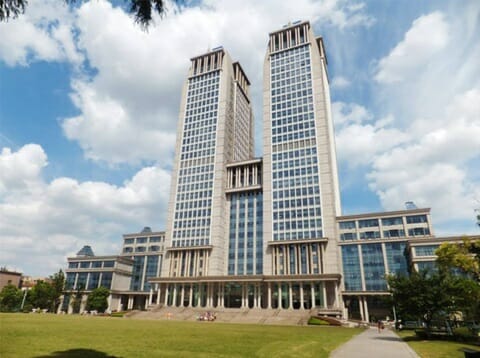
China’s University of Fudan, one of the hardest and most selective educational institutions in the country, announced that it opened a blockchain research center, with the intention of developing knowledge and resources to aid the approach that has provided solutions for several fields and everyday ventures.

A Collaboration of Several Parties to Aid Blockchain Research in Shanghai

After the announcement, the Shanghai Blockchain Engineering Technology Research Center has been inaugurated thanks to a collaboration of several parties, including the Fudan University, the Zhongan Online Property Insurance Co., Ltd., and Shanghai Zhongren Information Technology Co., Ltd.

On Friday, February 15th, the Shanghai Blockchain Engineering Technology Research Center put together a small ceremony to celebrate the news, at the Yifu’s Science and Technology building in the University of Fudan. Among the people present was the educational institution’s Vice President Zhang Ren.

Zhang Ren, also Vice President of the Shanghai’s Science and Technology Commission, congratulated the Shanghai Blockchain Engineering Technology Research Center and stated that the University will fully support the newly created initiative from the human, financial, and engineering standpoints.

Investigation and Training to Reinforce Production and Research

Vicepresident Ai Jianliang led the inauguration ceremony, after which a meeting to exchange views on blockchain technology matters took place. The Director of the University of Fudan’s Engineering Center, Professor Lu Haibin, said that the institution will perform basic investigation and blockchain technology training, reinforcing the production and research to aid the city’s economic development.

The reports coming out of China state that the research center will host a program for basic research about the blockchain technology and its applications. The primary goal is to promote the growth of the blockchain industry in China and the Asian area, which will help Shanghai economy lift off.

Other Universities’ Ventures with Blockchain Technology

Other universities have embarked in similar projects, including other Chinese institutions. For example, the Institute for Fintech Research at Beijing’s Tsinghua University (THUIFR) announced in January that it would begin to collaborate with the Ripple protocol to integrate blockchain into scholarships programs.

That program involving the Institute for Fintech Research at Beijing’s Tsinghua University (THUIFR) is purportedly eager to put together the most talented and prepared students in the country to research on blockchain regulations, development within the industry, and similar subjects.

The THUIFR joined Ripple’s network, known as its global University Blockchain Research Initiative (UBRI.) was launched in June 2018 and works hand in hand with universities to provide tools and support for academic research, technical development and innovation in blockchain, cryptocurrencies and digital payments. Up to this point, the Ripple protocol has partnered with 29 educational institutions as part of its program.

By Andres Chavez