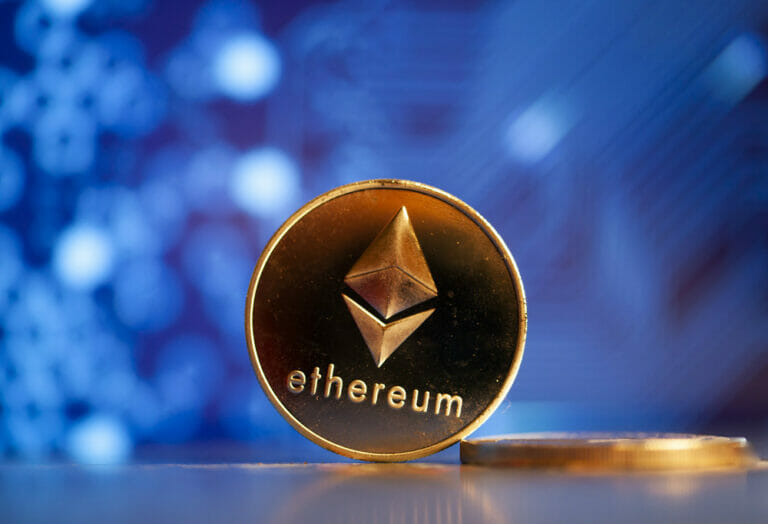
An Increase of 20% in the Ether Price Might Be a Trap for the Bulls

ETH is still down 71.3% from the all-time high reached in November, while the overall crypto market continues consolidating. Since many exchanges offer staking services, users can invest less than 32 to run a validation node.

The price of Ether (ETH) tests relevant psychological levels as it gets closer to the latest peak of the market cycle.

Ether is still building on the weekend gains during the Asian trading session this morning. The crypto asset rose to USD 1,412, adding 20% to its value over the last week.

ETH outperforms Bitcoin with a 3.6% gain over the last 24 hours, while BTC has dropped by 0.5%.

Crypto analyst and trader Bluntz pointed out that the price of ETH has recovered from the 200-week moving average, which might indicate it has bottomed out.

A Three-Day Pump Might Be a Bullish Trap

The long-awaited Merge of the Ethereum network with the Proof-of-Stake (PoS) protocol, scheduled for September 19th, has fueled the momentum.

The Ethereum developers recently ran another shadow fork to test elements of The Merge involving MEV (maximum extractable value). The final testing phase on the Goerli testnet will occur on August 11th.

However, the bears are not yet out of danger, as ETH is still down 71.3% from the all-time high reached in November. In addition, the overall crypto market is still consolidating.

Fed interest rate hikes and news about the recession in late July might trigger a final capitulation. If that brings the price of Bitcoin (BTC) back below USD 20,000, Ether will likely follow it.

A three-day pump could be a bullish trap as the asset has suffered a downward trend over the last eight months. It is relevant to remember that bearish markets usually last a bit longer than that.

However, those investing in ETH have been gradually hoarding the crypto asset. CoinShares reported that institutional inflows have returned to Ethereum-based products and funds, while there has been a massive Bitcoin sell-off.

Exchanges Increasingly Offer Ethereum Staking Services

On-chain analytics firm Glassnode recently reported that the addresses holding over 32 ETH reached a 16-month high.

Thirty-two is the number of tokens required to run a validation node. However, investors can invest less than that as many exchanges offer staking services.

According to explorer Beacon Chain, there is 13,089,105 ETH in staking. That is equivalent to around USD 18.3 billion and represents almost 11% of the total circulating supply.

Some analysts have speculated that there will be a significant sell-off of Ethereum once it breaks free from staking after the Merger.

However, the developers have confirmed they will not unlock everything to ensure network security and consensus.

Ether is trading at around USD 1,487 and has accumulated a 9.7% gain over the last 24 hours. While its daily trading volume is above USD 21.53 billion, its market capitalization is about USD 178.17billion, according to CoinGecko.

By Alexander Salazar

Despite the Uncertain Crypto Market, Nicholas Merten Predicts Bitcoin May Rise to USD 30

The upcoming Russian law will make paying with cryptocurrencies illegal, but citizens can continue to buy and mine them. Peterffy said, who believes the Fed interest rate hikes will lead to exploding debt, will buy more Bitcoin if it drops to USD 12,000.

Crypto analyst Nicholas Merten recently predicted a relevant rebound in the price of Bitcoin (BTC) amid the uncertainties in the market.

He believes there might be a relief rally in the market like in the past, besides an extended bearish trend.

From its current price, the expert foresees that Bitcoin may rise to USD 30,000, an increase of 42%.

The Russian President Signs a Law to Ban Digital Assets

Vladimir Putin, the President of Russia, recently signed a law prohibiting crypto assets and monetary.

The new law bans transferring or accepting cryptocurrencies as payment for goods purchased, work done, or services rendered. The legal document establishes exceptions for the prohibition in the use of those financial assets.

The law, coming into force in the next ten days, will make paying with cryptocurrencies illegal. However, Russians can continue to buy and presumably mine Bitcoin and other crypto assets.

The General Counsel of Andorra Approves the Digital Assets Law

Andorra, a small country between France and Spain, recently adopted a legislative framework for cryptocurrencies and blockchain technology. The General Counsel of the European nation approved the so-called Digital Assets Law.

The first part of the management concerns the creation of digital money people may exchange in a closed system. The second half of the law deals with using crypto assets as financial instruments.

Banks Want to Include Bitcoin-Related Technology in the Short Term

The US Federal Reserve (Fed) surveyed several national and international banks interested in including Bitcoin-related technology in the short and medium term.

Forty percent (80) of the banks expressed a medium to high priority to grow in developing products related to Bitcoin technology.

Thomas Peterffy Will Buy Bitcoin When It Drops to USD 12,000

Thomas Peterffy, a brokerage pioneer, firmly believes that inflation will last for years rather than months.

He recently explained the Fed increases the amount the country must pay to service its debt as it raises interest rates. He considers this a vicious cycle that will eventually lead to exploding debt.

Peterffy, who still has some Bitcoin, said he would buy more if its price reaches USD 12,000 per unit.

He also predicted that Bitcoin would very likely become worthless or illegal.

The Fed Might Raise Interest Rates by 100 Basis Points

In late July, officials at the US Federal Reserve might discuss a historic one percentage point rate hike.

Investors believe the central bank might raise rates by 100 basis points at its meeting on July 26th and 27th.

Michael Feroli, an economist at JPMorgan Chase & Co, thinks they have time to change that expectation. He considers they have not given a good reason to go slowly or gradually.

By Alexander Salazar

Celsius Customers Could Have to Wait even Years to Get Funds Back

Celsius had decided to send the entity to bankruptcy status, but legal specialists explained that settling customers could be a long and drawn-out procedure. The absence of clear-cut legal precedents further brings a more complex situation for the interested parties.

The prospects of Celsius’ creditors seeing back their funds from the exchange soon are looking minimal, with parties advised to brace themselves for a tense fight in court.

Celsius sent shockwaves through the crypto world when it stopped withdrawals last month, highlighting unfavorable market conditions. The move came along with a Chapter 11 bankruptcy filing in New York unveiling a $1.2 billion deficit in its balance sheet and over 100,000 creditors.

Six lawyers specializing in bankruptcy matters highlighted that settling the embattled firm’s creditors would be a dense process that could take years to get solved in its entirety. Other crypto entities like Voyager and Three Arrows Capital have also used Chapter 11 bankruptcy to rebuild their business.

No precedents to follow

Part of the reasons that caused the delay in court is the lack of previous judicial precedents to follow. James Van Horn, a partner at Barnes & Thornburg, spoke with reporters about how the bankruptcy code and courts would treat entities closely linked to crypto.

While a crypto exchange like Mt. Gox faced a bankruptcy process, there is a deficiency of cases in a crypto lender like Celsius for the courts to follow. Stephen Gannon from Davis Wright Tremaine expressed their thoughts about the peculiarity of the case and compared it to playing three-dimensional chess.

Gannon said it’s probably going to take at least six months, at a minimum, to develop a strategy to overcome this bankruptcy status.

Another aspect to consider when it comes to a possible extension of this bankruptcy process is Celsius’ classification of its creditors. The clients may supposedly get listed as unsecured creditors, and this class has no earmarked rights to access any funds or anything linked to the company. This situation could open the floodgates of legal complaints, potentially clogging any hopes for a quick resolution for the parties involved.

The Situation Between Celsius and Individual Investors

Individual investors show concerns about how their interests would be at the bottom of the pecking order, while the most prominent creditors will become the center of the case. Martin Jabou, an investor who injected $45,000 of his assets in Celsius, has been left holding empty bags following the project’s Crashdown.

He thinks the affected would be the last on the list to see this case solved and does not know how to deal with problems like rent or car payments, especially with the other debts included.

The Crashdown of Celsius raised the interest of other entities in investor protection in the crypto space. The deposits in U.S. banks got insured by the Federal Deposit Insurance Corporation for more than $250,000, while brokerage accounts got protected by up to $500,000.

In crypto, such shields are not usual, but increasing regulations and the hard lessons from Celsius could have brought tons of changes in the industry.

By: Jenson Nuñez

Germany and The United States of America Got Described as the Most Crypto-Friendly Countries

According to Coincub, Germany ranks in the number one position as one of the most crypto-friendly regions in Europe. However, Germany runs in parallel with the USA. Switzerland goes to third place in the latest Q2 rankings for 2022.

According to the latest report by Coincub, the German team disagreed about the results presented in the rankings of the most crypto-friendly region in Europe. However, Coincub says that Germany still ranks first along with The United States of America.

Both Germany and The United States of America ranked through various metrics. Germany achieved first place in the 2022 Q1 ranking, powered by the unprecedented decision of saving institution Sparkasse to allow Bitcoin investments.

The USA followed the European nation as the second in line but still hasn’t obtained the chance to surpass the said nation. Germany’s score might experience a boost in Q3 following the new regulatory procedure for crypto, titled: Markets in Crypto-Assets, conducted by the European Union.

Germany and North America

Coincub got these results assuming Biden’s push for better regulation regarding crypto, alongside the creation of anti-money laundering policies that will give the U.S. an improvement in the way they work with crypto this year.

The USA also entered the chart due to decisions made by Fidelity regarding pensions, highlighting in April that they would start trying crypto. Digital assets will become a vital part of the portfolios of their pension funds.

Coincub said that this situation is an endorsement of Bitcoin, and the same goes for the Sparkasse savings institution in Germany.

The final Ranking: Germany, USA, Switzerland, Singapore, Australia

Switzerland achieved third place due to solid legislation pointing at progress; this country also acquired skills to improve its high trading volumes. Coincub highlighted that The Swiss ranking got modified by the Canton of Lugano’s decision to employ bitcoin as legal tender. In Lugano, bitcoin can now serve to acquire everything, even taxes.

Singapore obtained fourth place in the ranking. The city-state achieved first place in the 2021 Q4 ranking but has, since then, given space to other regions. Singapore is still a crypto powerhouse due to a high concentration of crypto holders and ICOs. Obstacles to the third-party advertising of virtual asset service providers (VASPs) have lowered their numbers.

Australia in Q2 2022 crumbled to fifth place. Coincub said the country got overtaken.

More and More Movements

Sergiu Hamza is the Coincub CEO. He said that in the quarterly rankings, all moves from administrations to give legitimacy to crypto investment, safeguard consumers, and consolidate plans to boost a country’s economy based on crypto assets get a score based on their ranking criteria.

Coincub expressed that their latest rankings have already considered the recent market Crashdown in crypto prices, plus other significant data. These aspects might include government policies toward digital assets, current legislation, methods to pay taxes, investments, blockchain education courses, startups linked to the crypto space, and the status of CBDCs.

These factors might bring a more comprehensive view of the crypto economy and blockchain acceptance within every single region worldwide.

By: Jenson Nuñez

Beware of the Future: Are Blockchains Genius or Utopia?

Whether as part of its own evolution or in its ashes, its innovative heritage promises to be considerable.

A digital fabric offers the possibility of improving the reliability and efficiency of all types of transactions. These are, of course, Blockchains. According to its supporters, its transformative potential for transactions is comparable to the revolution that the Internet has brought about in information flows. Is it necessary to get on that train so as not to lose it or better to observe from a distance to see how its applications are decanted?

What Blockchains are about

The potential stems from the fact that it can document transactions with any asset: tangible (from land and another real estate to art objects); intangible (such as patents and other intellectual property); or in between (as in the case of digital images). And it also serves to track sequences of transactions and verify to which natural or legal person the asset belongs at any given time.

It is a digital ledger in which each block in the chain indisputably verifies the content of the previous one. In principle, you can get any transaction done very quickly, at a low cost, and documented in an auditable way. It is easy to imagine how Blockchains could, for example, transform the sale of real estate.

And for many private Blockchain companies (with limited access to members of their system) they could also offer a new way to control operations – from supplies to productive modules and income – and to build trust and reduce the vulnerability of traditional information systems. More complex applications can also incorporate smart contracts that reliably automate future transactions.

But it turns out that, for now, the most widespread applications of Blockchains (cryptocurrencies and non-tangible tokens used by collectors) are found in fundamentally speculative niches, with more bubble potential than stable mechanism; and that the promise of low costs does not seem to have become reality in almost any of the applications, while others have turned out to require enormous energy consumption.

Cryptocurrencies and NFTs

The reasons for being interested in cryptocurrencies range from the search (constructive or anarchic) ​​for a global alternative to national currencies to speculation and secrecy in financial transfers. Launched in 2009, Bitcoin was the pioneer currency and continues to be the most value-added currency, although it has been losing ground as the range of cryptocurrencies has expanded. The total value of the set of cryptocurrencies was 700 billion dollars at the beginning of 2018, of which Bitcoin represented 70%. At the peak of cryptocurrency valuation ($2.9 trillion in January 2022), Bitcoin represented 40%, and now that value-added has dropped, it still represents roughly the same percentage.

Scarcity is integral to the original design of Bitcoin and partly explains why its value has skyrocketed, reaching as high as $65,000 six months ago. But the uncertainties around its practical utility, its inordinate energy consumption, and the regulatory framework (many countries are considering how to fill the regulatory loophole that cryptocurrencies have been navigating) make the value of Bitcoin vulnerable and prone to big ups and downs. Currently, it is around $20,000.

The other widely used Blockchain application is that of NFT: digital assets with unique identification codes and with their property authenticated in a Blockchain-type ledger, which works on platforms such as Ethereum, inspired by the Bitcoin experience. The trading of NFTs – generally with cryptocurrencies – experienced a dramatic boom during 2021, both in quantity and value. Most of the transactions have been in art images (in the broadest sense of the term) and it has attracted collectors who have bid on some images to levels that go beyond even the notion of a bubble. The collection of the Bored Monkeys Yacht Club is one of the extreme examples: with a dozen images, each one was worth more than a million dollars (increasing its value 5,000 times in less than a year).

In short, regardless of how Bitcoin evolves – and even survives – it will have had a long-lasting effect on fintech innovation. Although many experts consider Blockchains an inept technology – or one with purely utopian merits – there are still people and institutions that are betting heavily on cryptocurrencies, NFTs, and other applications of what they consider to be a great idea. Whether as part of its own evolution or in its ashes, the innovative heritage of Blockchains promises to be considerable.

By Audy Castaneda

Gold is not the Only Precious Metal out there, Platinum is Also a Valuable Item

According to the WPIC, platinum is an item that should have a high value due to its purity, brightness, and resistance.

The world is drowning in a sea of economic uncertainty; prices keep elevating to celestial heights, and some consider investing in lesser-known precious items; platinum appears to be one of these chosen ones. According to Coininvest, diversifying portfolios and betting on this kind of investment as a refuge value is a good option.

According to Daniel Marburger, Director of Coininvest, platinum is a metal that receives a high value due to its purity, brightness, and high resistance. In this sense, he describes that it has value due to its density and stability, which is a good option in areas like health and electronics.

According to Marburger, platinum is anti-allergenic, does not rust, and survives extreme environmental conditions. On the other hand, as Marburger explains, platinum surpasses by 40% the cost of white gold.

According to data brought by the World Platinum Investment Council, the momentum behind the hydrogen economy and the technologies linked to green hydrogen made from renewable electricity is growing.

This momentum is evolving so fast that it could satisfy up to 25% of the world’s energy requirements and become a reachable market of at least 10 billion dollars by 2050.

The current EU and China green hydrogen generation capacity targets would need more than 300 oz platinum by 2030. As the hydrogen economy evolves, it would bring advantages to the acceptance of electric vehicles.

The growth of the FCEV market could generate high demand for platinum, giving a consolidated foundation for platinum as a valuable asset. The use of platinum in FCEV would surpass an additional 1.5 Moz per year in 2030.

On the other hand, during the market turmoil registered in 2020, investors sought safe-haven assets, and platinum surpassed gold, experiencing an increase of 80% versus gold’s 26% rise in January 2021.

After this event, platinum’s price performance did not happen because of the rising investment demand. This performance got sustained by its growing industrial demand and strong demand for platinum jewelry which, combined with limited supply growth, maintained positive investor trust despite a slight demand in the automotive sector.

Platinum and Digital Assets: Stablecoins

Stablecoins have direct ties to various currencies like dollars or precious metals. This combination of precious metals with technology can create new crypto items like Platinum Coin or Silver Coin.

PlatinumCoin counts on a security based on ERC-20 stablecoin that finds its base on the Ethereum blockchain and receives power from a smart contract. There is currently no method to set a limit on payments due to the strength of blockchain technology.

Because these assets got attached to these metals, they go through less market volatility than digital assets like Bitcoin often do. Those who deal with stablecoins do not typically suffer losses when trading because stablecoins never fall below the underlying supportive price.

Crypto backed by precious metals is gaining more attention and appreciation, which means it, is essential to understand its nature.

By: Jenson Nuñez