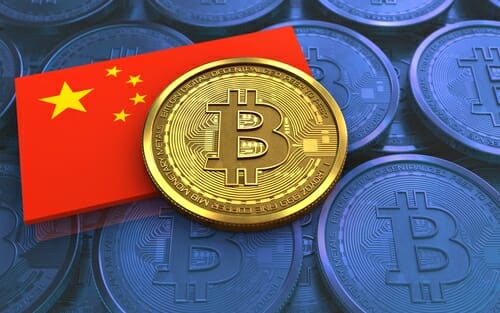
China Ranks 34 Cryptocurrencies: Bitcoin is 18th and EOS Holds the Top Spot

Cryptocurrencies are a hit in China. Despite the recent market slide that saw Bitcoin going from $6,500 to less than $3,300 in a span of just a few days, it has now recovered somewhat to surpass the $4,000 threshold, the most populated country in the world has not lost faith in digital assets, and since May, the government has been sponsoring a “crypto ranking” to keep a classification of the better and most stable projects.

Last week, Chinese authorities published the latest ranking of the best cryptocurrencies, with Bitcoin (BTC) controversially outside of the top 15 and EOS, a domestic blockchain platform, leading all digital assets.

The ranking is released by the China’s Center for Information and Industry Development (CCID,) an organism that operates under the Country’s Ministry of Industry and Information Technology administration. The list appeared for the first time in the month of May, in 2018.

Ranking Criteria

The primary criteria for putting the ranking together are basic tech, applicability, and creativity. There are more than 30 coins listed (34 to be precise,) and every time a ranking is published, it comes under severe criticism and controversy, mainly because Bitcoin, the world’s leading cryptocurrency and the most valuable digital asset (surpassing $4,000 today after a recent mini surge) is constantly ranked outside the top spots.

EOS also held the top spot the first time the rankings were released. The December 21st listing is the eighth issued of the rankings, with EOS once again looking every other cryptocurrency from above. Ethereum, the third most prominent digital asset by market cap, is second on the Chinese list.

GXChain, which is a local project in the data economy sector, came in third after ETH. “Public blockchains with high performance and support for general application development are generally ranked high. Among the top 10, four public chains adopted graphene architecture with better performance, six public chains use the dPOS consensus mechanism, and seven public chains support Dapp development,” according to a statement of the CCID after it released the latest results.

The Rest of the Top 20

The top 20 is completed by Komodo (fourth,) Ontology (fourth, tied with Komodo,) NULS (sixth,) Nebulas (seventh,) NEO (ninth,) Steem (tenth,) Lisk (eleventh,) Ark (twelfth,) Stellar (thirteenth,) Waves (fourteenth,) Ethereum Classic (fifteenth,) Qtum (sixteenth,) Cardano (seventeenth,) Ripple (nineteenth,) and Monero (twentieth.) The position of Ripple (XRP,) the world’s second largest cryptocurrency according to market cap, is also surprising.  

Despite being ranked number one in China, EOS has endured it fair share of criticism in the last few months because an apparent lack of decentralization, and their transaction reversal capabilities. BitShares (BTS) is ranked seventh: it shares the same creator – Daniel Larimer – as EOS.

Ontology is one of the additions to the list. “Its main network was launched in June 2018. In this assessment, Ontology has outstanding performance in basic technology and application, with a composite index of 112.6, ranking fourth in the [overall] list,” explained the CCID.

By Andres Chavez

United Arab Emirates will Present Regulation for ICO in 2019

The Government of that country will publish the document during the first semester of next year

A financial regulator from the United Arab Emirates (UAE) will present the regulation of the initial supply of currencies (ICO) in that country at the end of the first half of next year. The news about the development was announced on December 21st. The purpose of the measure is to provide companies with another way to raise capital.

The Securities and Commodities Authority of the United Arab Emirates (SCA), which regulates and supervises the markets, approved ICOs as securities and will work with the Abu Dhabi Stock Exchange and the Dubai Financial Market to develop a platform for trade of ICO tokens.

SCA’s Executive Director, Obad Al Zaabi, said the regulator “closed deals with law firms to create the testing environment and the rule books for the ICO issue”. Zaabi added that the legal requirements will be completed by the end of the first half of 2019.

Through an official article it is explained that the term “regulatory testing environment” refers to “a framework which facilitates the development of the financial technology industry”.

The expert indicated that the market is open. The ICO registration and license are available for all types of companies, from all over the world. “There is demand, we have already received a couple of requests for the issuance of cryptoactives and tokens”, he said.

The United Arab Emirates has presented other initiatives that can have a positive impact on the adoption of blockchain technology in the country. This year, the Advisory Council of the United Arab Emirates Banks Federation (UBF) discussed how to apply blockchain technology to its member banks.

In addition, the central bank of the United Arab Emirates is collaborating with the Saudi Arabian Monetary Authority (SAMA) to issue an accepted cryptocurrency in cross-border transactions between the two countries.

The SCA, on the other hand, showed no interest in traditional cryptocurrencies, stating that “Bitcoin, Ethereum and others are not our problem. We are more concerned about the emission of cryptoactives and how to bring them for commercialization in our bags”.

This institution indicates that it has also received requests to issue digital assets. But its representatives assure that “SCA considers safety as the main priority”; therefore, it will reserve the right to decide which ICOs may be issued in the country.

Similarly, Al Zaabi praised the blockchain technology, and described it as a factor that could add value to the infrastructure of the current UAE systems and markets.

“It will introduce layers of safety and efficiency. Especially changing local markets and volatile financial markets need international technologies such as blockchain to increase the speed of transactions and reduce overall costs”, said Al Zaabi.

By María Rodríguez

Spot, an Application to Control Wallets and Exchanges in One Place

This feature allows users to save the time it takes them to go from one exchange to another or from one wallet to another

Having all the cryptocurrencies and wallets in only one place is possible thanks to Spot, this is, a mobile application which allows all users to manage their wallets, even if they are registered in more than one exchange and have more than one wallet at their disposal.

At a glance, Spot is similar to other applications that only allow viewing the user’s portfolio without any interaction with the funds registered there. However, unlike the others, it has a section where those who use it can connect to their different accounts by using their API keys.

So far, the application is available for iOS and Android totally free and supports the exchanges: Binance, Kraken, Bitfinex and Poloniex. In accordance with what was proposed by its creators, it is expected that in the near future the application will support many other sites, to provide greater diversity to those who are interested in using it and to adapting it to the current needs of the users of the crypto world.

How does it Work?

At the first moment where the application is installed, those who use it can connect with their wallets by adding public addresses. If the person keeps his/her tokens in a physical wallet, such as Trezor, Ledger, Spot can read the public details of the wallet and show them in the application, so this is not an impediment to them fulfilling his functions.

Among other features of the application, it has the property of showing the person, with detailed graphs, the balance sheets on all the services related to their different accounts. It also offers the possibility of discovering which token is having a better behavior than the rest of the user’s tokens.

“We have our own nodes in Ethereum, Bitcoin, Litecoin, Stellar and others to recover the amount in their wallet”, said Nicolas Steegmann, CEO and cofunder of the Stupeflix web tool. The data is also cross-checked with third-party services to make sure everything is fine.

But Spot does not rely on an API to get price information for each token. “We have rebuilt CoinMarketCap from scratch, and we are one of the few companies that have done so”, added Steegmann. The company stores price information for dozens of tokens in 150 exchanges.

As expressed by Spot’s developers, in the next updates of the App users will be allowed to trade within the application. According to the creators of the project, the design of this App will also be an attraction for those who use it.

For now, the company says it does not plan to create its own exchange, but rather considers saving the need to visit the website of each exchange in which they have accounts. The company has built a solid foundation to add more features in the coming months. Spot wants to become the gateway to the world of cryptocurrencies for those who are not yet part of it.

By María Rodríguez

Christmas Cards Become Donations on Ethereum for Venezuelans and Spanish People

Two projects sell Christmas cards and the earnings in euros, dollars and cryptocurrencies will be delivered to families in Venezuela and to children in Spain

Greeting a loved one at the distance and expressing love and good wishes in Christmas, through apostcard, is a tradition that has not been completely lost.

This year, two initiatives of the Ethereum technology will not only make possible to send Christmas cards to family and friends, but also raise funds to contribute to noble causes such as financing the creation of activities to pull at peoples heartstrings in virtual reality spaces for hospitalized children and elderly people with some type of disability, which is made by a non-government alorganization called Voluntechies.

It is a leap into the digital era and a charity event promoted by the Ethereum company. The Spanish laboratory specialized in blockchain technology NWC10Lab and the creativeagency CLV, created the first of these two projects, which is called Christmas Blockchain.

To access this function, interested people should only visit the website: www.christmasblockchain.org, where users can send their digital Christmas cards registered on the Ethereum block network to their loved ones.

Hence, one particularity of the blockchain and Ethereum networks is to guarantee the unique character of the objects that are created on these platforms, in this case, the Christmas cards. This is how, by using HASH codes, each card sent or developed is unique and original to that loved one. Similarly, its social valuemakes it special.

How to Send those Christmas Cards?

On the official project page, it is indicated that users interested in using the service can choose between four available designs. To do this, they must select the model they like the most and click on the “Continue” button.

Once the design is selected, a window appears in which the postcard is customized. To do this, it is necessary to provide the names and emails of both the sender and the recipient. Just in this area there is an additional section in which the participant can write the message he wants to send on the digital card.

The next step is for the user to indicate the amount of money in euros he wishes to donate for the postcard. The minimum amount is one euro and the donation is made through PayPal, following the “Donate” button. The developers of the project assure they work so that the donations can also be made with Bitcoins.

Once the payment is confirmed, the respective card is sent to the recipient through the previously indicated email, where the message will be outlined along with the amount donated to Voluntechies, and a QR code with the HASH of the postcard.

In addition to Christmas Blockchain, the NWC10 Lab team has other projects which use Ethereum’s Blockchain technology, such as Bit2me, Tikebit, Blocknap, Muchacomida and100Thanks.

Cryptoxmas is the name of the second initiative for sending Christmas postcards. This platform uses Ethereum’s smart contracts to create a non-fungible (collectible) token that is sent to the honorees along with a small amount of ETH.

To decorate the card, Cryptoxmas designers donate their art and each of these images represents a token. The funds that are sent next to each token are destined to cover the gas of the network and to donations destined to 100 thousand families in Venezuela. Each one of them will receive USD10.

To distribute the donations, CryptoXmas works jointly with the organizations Bitcoin Venezuela and Airdrop Venezuela. It also forged alliances with crypto community members such as Raiden and Trust Wallet.

 This DApp was built on the decentralized charity platform Giveth. In November, the DecentralizedAltruistic Community (DAC), also built in Giveth, channeled financial contributions to projects that won the Blockchain4humanity (b4H) 2018 awards,held in Chile, from December 5th to 8th.

 By María Rodríguez

Facebook Plans to Create a Dollar-Pegged Cryptocurrency

The stablecoin does not yet have a release date. One of its objectives is to facilitate the remittances and transactions sending among users

Kik Messenger may not be the only messaging application in which people can make payments with cryptocurrencies. Facebook is working on the creation of this popular digital money system so that users can make transactions, according to reports from nearby sources.

The goal of the prestigious and recognized social network, which was created by Mark Zuckerbergin 2004, is to provide users with the possibility of transferring their moneythrough this application. The first objective is to favor the remittancemarkets in India; although the function could later expand to other countries.

The company looks for the type of currency, such as how to reduce the instability of its value. For this reason, stablecoins exists. They are pegged to the value of the dollar in order to be safer and more useful for users.

Complying with these characteristics, it is possible to avoid volatility problems. In this way, and more in the future, the receiver can change their cryptocurrencies into fiduciary currencies whenever they wish.

According to the nearby sources, Facebook is working on the development of the concept and in the strategy, which will guarantee the correct functioning of this cryptocurrency.

Up to this point, the exact date of the launch is unknown and the company has not publicly presented any strategy for the use of decentralized technology. Before reaching this point, the company will be defined as the way of handling the custody of this cryptocurrency, for the peace of mind of the users.

The company began its foray into the world of strategic messages, through David Marcus, PayPal’s former President and, currently, the vice president of Messaging Products at Facebook, where the Facebook Messenger unit is. He also is related to Blockchain technology projects.

He experiences the possibilities of using the blockchain technology in alliance with the well-known social network and is the one who promoted the payment with Litecoins through the Facebook Messenger messaging application, where users can currently make peer-to-peer payments with this altcoin without leaving of the message platform.

In addition to Marcus, Facebook has hired more than 40 experts in blockchain technology. A spokesperson for the company said: “Like many other companies, Facebook is exploring ways to harness the power of blockchain technology. This new and small team is testing many different applications”.

In fact, in July of this year, Facebook announced the incorporation of Evan Chang as the Blockchain Technology Director for the company that is a department he has managed sinceMay 2018.

2018 has been a year for cryptocurrencies’ world constant expansion. Some governments, companies from different fields and even banks raised the possibility of launching their own cryptocurrency. However, Facebook would be the first great technology company to do it so.

This type of initiatives, in which a large number of users can participate, are those that would help open the doors to digital assets for their massive adoption and their application in everyday life. The community that follows the progress of cryptoactives expects more news about it and wants 2019 to be a year for the cryptocurrencies’ world growth.

By María Rodríguez

Comcast Will Develop “Blockgraph,” a Blockchain Product, in 2019

Comcast, one of the biggest telecom companies in the United States and the world, has taken another step towards blockchain mass adoption. According to its plans, the firm intends to introduce Blockgraph starting from next year. The information was provided by the conglomerate itself via a press release on December 21st.

Blockgraph is a blockchain project, in the form of a product, made for securing personal data and sharing information. “Comcast is currently working with NBC Universal to test Blockgraph’s capabilities with plans of incorporating it into its addressable offering in early 2019,” according to the text.

Comcast is a media company that offers multiple things, but is famous for providing cable television, Internet and telecoms services. It is the largest in America and the second biggest in the broadcasting field worldwide.

Strategic Partnerships

The company’s Cable Advertising department has already started the next phase of the Blockgraph platform, with the culmination scheduled for 2019 with its official launch. Other prominent companies such as Viacom and Spectrum Reach, are also taking part on the exciting project.

Thanks to Blockgraph, the TV field will be able to enjoy an “identity layer,” letting media enterprises share non-identifiable audience information and data. It is a peer to peer ecosystem that intends to optimize the way TV marketing and advertising are being approached.

The President of Spectrum Reach, David Kline, expressed that “it’s imperative that the use of data prioritizes the privacy of consumers’ personal information. Blockgraph’stechnology offers enhanced security and privacy protections by allowing all players within the TV ecosystem to directly share insights derived from anonymized and aggregated information.”

Comcast has a notorious reputation in American media for establishing a telecommunications monopoly in several areas. Some circles recognize it as the worst company in the country. However, the most recent piece of news is proof that it can also contribute to the blockchain development and its adoption in a wider scale.

Blockgraph is not the only project that Comcast has been working on when it comes to the distributed ledger technology. It has invested in its own products, and it also has contributed, invested or supported in others, as well. For example, it led a $3 million venture capital seed round by a New York-based startup namedBlockdaemon. The money was going to be used to “enhance infrastructure options, and to help customers run multi-tenant networks across all sorts of different blockchains.”

A little bit more about Comcast

Comcast is an American entertainment and communications consortium created in 2001. It is one of the few truly global telecom conglomerates in the United States and the planet due to it provides various services.

It is headquartered in Philadelphia, and firmly belongs in the top five of the most influential broadcasting and cable television companies in the planet by revenue and worldwide fame.

Comcast also offers home telephone services and produces films, series, and multimedia content because it owns NBCUniversal, one of the top entertainment options in the United States. It also manages Telemundo, MSNBC, CNBC, USA Network, NBCSN, E!, and the film studio Universal Pictures, not to mention Xfinity.

By Andres Chavez


 [W1]This name is not clear. Check it out.