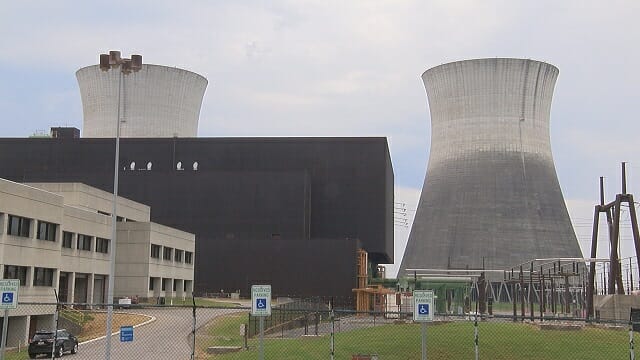
Mining Material is Confiscated in Ukrainian Nuclear Plant

The state energy company Energoatom has at its disposal four nuclear plants in Ukraine

The Security Service of Ukraine managed to confiscate special equipment for cryptocurrency mining at the installations of a nuclear plant.

According to information issued by local media, on July 10th, in a nuclear plant located at the south of the country, a series of equipment that were used for crypto-mining activity were discovered and confiscated by the Ukrainian Security Service (SBU). Said equipment was used to mine cryptocurrencies using energy and resources from state-run facilities.

Among the equipment confiscated are: a motherboard, extension cables, batteries and equipment for energy supplements, six video cards model GPU radeon RX 470, units for cooling electronic equipment and large capacity hard drives.

It was known that the specific location of this equipment was hidden in a single office that was in disuse, under number 104, in an area for administrative processes. The place was far from the reach of some sectors of power in the facilities of the government company, Energoatom.

Not even a piece of the equipment transferred to the plant has authorization to enter, because the power facilities are considered a state secret. For this reason, the security levels are high and represent many access restrictions; this means that a lot of the equipment associated with mining activity had to enter clandestinely.

After making the first finding, The National Guard of Ukraine managed to find another series of equipment that was also destined for digital mining inside the plant. The other devices found were classified as additional and now they are under investigation with the rest of them. Seven hard drives, routers, two large storage memories, and 16 GPU video cards were added to the confiscation.

It is important to highlight that most of the equipment found can be considered as old equipment for mining since there are more and new models with better mining capacity in the market. Among those devices are the GPU video cards, which may be of lower rank than the current ones.

The Ukrainian Security Service decided not to answer the press and it was limited to give only the statement, so it is unknown what kind of cryptocurrency was being mined or if someone was arrested for the operation. They only added that new investigations will be conducted to help clarify the whole case.

Among related data to the case, and according to additional reports, it was recalled that in 2017, activists of the Cyber ​​Alliance of Ukraine made a “flash mod”, using the hashtag #fuckresponsibledisclousure.

The objective was to show concern about the safety of large state enterprises national impact, such as the energy company Energoatom.

It is known that Ukraine is one of the countries that are working to launch their own official cryptocurrency; Ukraine´s cryptocurrency will be named: e-grivna.

Although Ukraine accepts cryptoactives, officials of the National Guard of Ukraine who guarded the plant can be accused for allowing mining activities not allowed by the authorities in that country and in an unauthorized power plant.

By María Rodríguez

Plasma: side chains to improve Ethereum’s scalability

Some of the projects that use Plasma are OmiseGo and Loom Network. The first public deployment of Plasma Network was conducted in February.

Plasma was created in order to help the scalability of the Ethereum blockchain. It is a solution to register transactions and smart contracts on one or several side chains of Ethereum, to alleviate the demand on it.

This network provides a framework for building applications off the main chain that are safe, scalable and quick to execute. It serves to improve the operation of various applications for games, databases and payment networks. Plasma can be applied to other blockchains besides Ethereum’s.

It was officially presented as a project in 2017 by Vitalik Buterin, founder of Ethereum, and Joseph Poon, developer of the Lightning Network project, under the name “Plasma: smart, scalable and secure contracts.”

The scalability of a network lies in its capacity to handle an increasing amount of work and its readiness to expand until adapting to this growing demand. In the case of blockchains, the focus is mostly on the performance of transactions. Thus, Plasma was presented as a project aimed to reduce the data load on the main chain, reducing costs and increasing the speed of transactions, but without sacrificing security.

How does it work?

Plasma allows the existence of crypto assets on a root chain and on a side chain to be safe. The fundamental principle of Plasma is that all crypto assets can return to the root chain in case of a security failure on the side chain. Thus, this solution allows taking advantage of some utilities of the side chain (such as low-cost transactions) while keeping crypto assets secure.

Applications developed with Plasma tend to use common building blocks. In this way, applications require a smart contract implemented on another blockchain that serves as the root (such as Ethereum). The smart contract is configured with special rules that guarantee that user funds are always secure.

Plasma MVP is a design for a simple blockchain, based on UTXO. This implementation allows high-performing payment transactions, but it does not allow more complex constructs on the blockchain, such as scripts or smart contracts.

Plasma Cash, for its part, is an implementation using non-fungible tokens to represent fixed amounts of crypto assets. It provides greater security against hacking and is intended for collectible games, as well as for supply chain management and logistics. This implementation reduces the amount of data that users must process, since depositing a certain amount on the Plasma Cash chain allows the user to receive a single token for that amount, which cannot be divided or merged.

Plasma Debit is a combination of Plasma Cash and Lightning Network. Consequently, each token in this implementation is a payment channel between the user and the operator of the chain. Users send crypto assets to the chain’s smart contract and a single token is created, as in Plasma Cash. However, this token is also a payment channel, ideal for individual operations, especially micropayments.

Plasma has also been examined for other uses. Plasma Snapp, for example, aims to reduce the complexity of Plasma, thus paving the way for more complex protocols than just token transfer. Plasma Bridge, for its part, would allow two different blockchains to interact with each other through a shared plasma chain, thus allowing atomic exchanges.

By Willmen Blanco

Code for Telegram’s TON Blockchain Will be Available on September 1st

Telegram, one of the world’s leading social platforms and messaging apps, announced its TON (Telegram Open Network) blockchain project back in 2018. Now, however, the company is ready to release the needed code to run a TON node at the start of next month, on September 1st, as reported by a prominent specialized crypto news site this week.

The site quoted people familiaried with the situation in its report, and one of them is actually directly associated with TON Labs, which is the tech startup that the token sale investors of Telegram created.

The platform had not published too much information about TON, managing it discreetly instead. No public announcements have been made at the moment of writing this article by the influential social app.

TON Labs: the Voice of the Project

TON Labs, a venture that was founded with the intention of building developer tools for Telegram, has been a little more vocal about the project than Telegram itself, becoming one of the few, if not the only, voice associated with the ambitious project. People at TON Labs have reportedly kept in constant touch with Telegram’s development team.

Up to this day, the TON test network has only had one operational node, and it is run by Telegram. However, with the code release scheduled for September 1st, a larger pool of users will have the ability to run their own nodes.

One important thing to note, though: users can only run nodes on testnet, and the mainnet launch is currently expected to materialize on October 31st, per the Telegram’s token sale purchase agreement, published last year.

More details came to prominence thanks to Russian news site Vedomosty. According to a report from a mid-week report, the release will contain code for the node itself, but also instructions to deploy one.

Vedomosty quoted investors that preferred to stay anonymous in its report. It also stated that developers that are interested will have the opportunity to use their nodes as a mean to test the protocol’s consensus and sharding resources.

Technical Details

Per a whitepaper that was leaked to the web, the TON will implement a Byzantine -fault-tolerant proof-of-stake consensus with “infinite sharding.” Additionally, it will be able to support an impressive 292 shardchains (49 followed by 26 zeros).

Russian and American investors contributed loads of money to Telegram, with a minimum of $1.7 billion between the two countries and several others that invested to a lesser degree in the token sale held in 2018.

In the event that the network is not launched by October 31st, Telegram will reimburse its investors per the agreement, without any expenses that are development-related.

The crypto industry as well as investors remain very interested and engaged in Telegram’s blockchain project, and are eagerly waiting for it to materialize. The original launch date was actually December 2018, but several unexpected delays have made sure that was not the case.

Because of the delay, numerous investors sold the rights to their future GRAM tokens, the digital currency associated with the project, and this caused that a secondary market was formed. It is a violation of the investor agreement of Telegram, though.

By Andres Chavez

Binance Unveils Lending Service with a Maximum of 15% Annual Interest

Binance seems to be on the news every day. After claims of a KYC leak that occurred recently, the prominent and influential cryptocurrency exchange has announced the inclusion of a service for its customer base, one that they will surely appreciate given its potential benefits.

The platform developed and launched a lending business, in an effort to entice clients’ deposits. One of the planet’s largest crypto exchanges by trading volume, Binance stated this week that Binance Lending for clients that want to subscribe from August 28th, exactly at 6:00 UTC, under the first-come, first-served model.

USDT, Ethereum Classic, and Binance Coin

Starting from that moment, users that so decide will have the ability to lend their dollar-pegged USDT, Ethereum Classic (ETC,) and the platform’s native cryptocurrency, the Binance Coin (BNB) with the intention of gaining interests that will be payable from August 29th to September 11th.

For now, the platform set a 15% rate for annualized interest rate for BNB, a 10% rate for the USDT assets, and a seven percent rate for ETC. They all have a 14-day fixed maturity term.

As for the total subscription cap initially set by the Binance platform, it will be 200,000 BNB, 5 million USDT and 20,000 ETC. In the event that all of those get subscribed completely, the exchange will have to pay out interests of 1,150 BNB, 19,178 USDT and 53 ETC, roughly $50,000 at the moment of writing this article.

Details of the Offering

To maintain a level playing field, each user’s account present on Binance will be hard-capped for BNB-, USDT- and ETC-, at 500 BNB, 1,000,000 USDT, and 1,000 ETC each. Meanwhile, customers that borrow BNB and USDT will be charged an annualized interest of 109% and 10.0375 as a maximum by the margin trading business that the exchange launched to the market recently.

A couple of hours prior to the launch of the lending business, Binance stated on its web page that it will increase the annualized margin borrow interest rate for Ethereum Cash: it will go up from 7.3% to 14.6%, from August 27th.

According to Binance, it will be “constantly evaluating new coins and tokens to support as lending products based on demand,” with new offerings being revealed on Mondays and becoming available for lending on Wednesdays.

An Ever-Growing List of Services

Whilst the launch of a lending service is extremely helpful given the interest rates and potential earnings, the development does not come as a surprise, as Binance’s CEO Changpeng Zhao had revealed the firm’s plans to come up with such a platform days ago.

In a market that is becoming more competitive than ever, Binance’s efforts to increase its offerings towards its customer base are noteworthy. The company is working to diversify its catalog with the intention of luring even more clients to the already big ecosystem.

Just weeks ago, the exchange presented margin trading and borrowing, and there are plans to add futures trading services in the not so distant future.

By Andres Chavez

Bitcoin Seller Who Ran Unlicensed Bitcoin Exchange and ATM Faces Life Sentence

Offering valuable assets, like cryptocurrencies, should only be done with proper permission for the country’s financial regulators. Otherwise, the customer may be risking losing funds to unreliable platforms and service providers. After all, hacking attacks, scams, and frauds are increasingly common since the boom of cryptocurrencies.

Unfortunately, a 25-year old man from Westwood, a location in Los Angeles (California, United States) recently pleaded guilty to several charges, accused of exchanging approximately $25 million in cash and digital assets without the necessary permissions from a financial watchdog in the nation, nor compliance with the anti-money laundering scheme.

The “Coinman” Has Agreed to Plead Guilty

The man’s name is Kunal Kalra, and he goes by the pseudonyms of “Kumar,” “shecklemayne” and “coinman.” He was indicted over the weekend, for performing crypto trading operations and transactions for drug dealers and other people with legally questionable backgrounds, through his bitcoin ATM kiosk.

The news was announced by the US Justice Department. The institution has informed that the man has already agreed to plead guilty to the charges, and he is scheduled to appear in court for the first time in September.

“Kalra established bank accounts in the names of others, including fake businesses, which allowed him, for a time, to conceal his illicit business activities, court papers state. Kalra also admitted to operating a kiosk – essentially an ATM – where his customers could exchange Bitcoin for cash and vice versa. Kalra profited from every transaction conducted on the ATM. Customers who sought to do an exchange using this ATM were not required to provide their identities and Kalra did not install a camera or implement any features requiring customers to identify themselves, the plea agreement states,” according to the released document.

According to the press release by the US Justice Department, the accused managed a crypto exchange business from May 2015 to October 2017, and it functioned without a license. He also conceded that he exchanged BTC for cash with criminals who got the digital assets by selling drugs on the dark web.

Failing to Implement the Anti-Money Laundering Program

According to the department of justice, Kalra failed to implement the anti-money laundering program whilst serving as a facilitator of the mentioned transactions and earning a commission for his services. He knew that the funds’ origin was tied to drug dealing activities.

Law enforcement agencies seized nearly a million dollars from Kalra (the exact number being $889,000) as part of the investigation. These organizations also took 54.3 BTC and other crypto assets from the criminal, which added up to nearly $500,000.

More details on the case, per the release: “In June 2017, Kalra sold nearly two pounds of methamphetamine to an undercover law enforcement official in exchange for $6,000. Kalra and the undercover agent later met at a coffee shop in Signal Hill to exchange $50,000 in Bitcoin for cash, which the undercover agent represented to Kalra was the proceeds of the sales of the methamphetamine that Kalra had sold to the agent, the plea agreement states.”

According to the announcement, Kalra could face a maximum penalty of a lifetime in prison.

By Andres Chavez

Operations with Cryptocurrencies Imply that Companies Should Pay Taxes

Faced with the devaluation of the bolivar, cryptocurrencies are a tool for money management in Venezuela. These are also an option to strengthen the employee-company relationship.

Mariela Llovera, a Venezuelan lawyer and graduate in Industrial Relations, is part of the team of Nayma Consultores, a company of which she is a co-founder and dedicated to advice on Finance, Human Resources and tax matters. Llovera has ventured into the field of advice on cryptocurrencies, especially on how companies and individuals should address the tax aspects concerning their use.

Some of her clients had bought Bitcoin that they would later sell, but they did not want to have tax problems on their accounts abroad. That information led her to learn that large companies were already touching the subject. Besides, the large amount of material that she consulted allowed her to understand the mechanisms to adhere to the tax regulations regarding the operation with cryptocurrencies.

Then she was able to give effective advice on this matter to her clients, who managed to liquidate their bitcoins at the peak of that cryptocurrency in 2017. They were able to prove to their banks abroad when an operation was legitimate and where they had obtained the funds.

Experiences with Cryptocurrencies

Her first experience with cryptocurrencies was when she gave direct advice to her clients. Now her team has an application at the company’s online store to receive payments in cryptocurrencies. This has allowed them to receive bitcoins from abroad, for services like online advice.

Additionally, she has worked with her team on an employee payment project, doing all the legal and administrative analysis of the project, to use cryptocurrencies as a means of paying workers.

He has also used cryptocurrencies to pay for goods and services, especially at a store and at a couple of restaurants. Thus, she has had various experiences in which he has made and received payments with them.

Convenience of Using Cryptocurrencies for Payroll

Llovera believes that using cryptocurrencies to pay employees is valid, as long as workers, finance and accounting people are trained on how to keep track of these volatile assets. There may be both gains and losses in the process, which should be reflected in the financial statements as transparently as possible.

On the other hand, cryptocurrencies are an option to strengthen the employee-company relationship, as well as provide compensatory benefits regarding salary. This point is of the utmost importance, as companies are facing high costs due to the rotation and training of their employees, and they do not always find suitable candidates for vacancies.

Currently, additional benefits such as food tickets do not actually work, since the “incendiary” effect of hyperinflation burns them as soon as they are received. What employees require is “hard money” to acquire what they need, which they can do with cryptocurrencies.

Besides, attention needs to be paid to Decree 35 on cryptocurrencies and foreign currencies of December 28th, 2018. This decree states that when the tax base is invoiced in foreign currencies, taxes in foreign currencies must also be declared.

Cryptocurrencies and her Company

Llovera says that her company uses cryptocurrencies every day, which has facilitated payment from five of her clients. She notes that they use cryptocurrencies because their technology team developed an application that allows updating prices at their online store, through Bitcoin’s alternative quotation.

Some of her clients work with technology, and so to them payment with cryptocurrencies is the most normal thing in the world. Of course, if people start using them massively, they will include it in the advisory package.

By Willmen Blanco