Banknotes Are Revalued through Artwork Alluding to Bitcoin

Artists use cash as the raw material for their artwork. Karina Monaca has a collection of banknotes inspired by Bitcoin, Caracas and renowned paintings.

Graduate Architect and artist Karina Monaca heard of Bitcoin through a friend, who is immersed in the world of cryptocurrencies. In this way, she became interested in the cryptocurrency created by Satoshi Nakamoto, considering that it was a project unlike any other that she had ever heard before.

Karina designs banknote paintings based on irony, considering that it is “a mixture of things that are similar but different at the same time.” The bolivar is worthless paper money, whilst Bitcoin is digital money that is worth a lot and whose price is revalued. The two-way game hooked her and she has made two other banknotes of masked characters with Bitcoin to express the privacy that this cryptocurrency grants to its users.

The artist works to order producing a cypherpunk bolivar inspired by the group of bitcoiners @satoshienvzla. Even though she trades the banknotes, she also has a private collection of paintings designed by her.

A Voice in Protest

Karina Monaca has been enthusiastic about her art alluding to Bitcoin, but she has been doing it for a short time, taking into account that the artist has been painting banknotes since 2015. The idea started due to the frustration that Karina felt with the hyperinflation in the country, which had rendered the lowest denomination banknote at that time worthless.

In this way, Karina prevents banknotes from ending up in the trash and a person has the opportunity to take home a rare object that is the product of a difficult economic, political and social situation. Her protest remains on her banknote canvas, with which she immigrated to Buenos Aires three years ago.

Not only Bitcoin or the famous paintings by accomplished artists are part of Karina’s gallery, but also paintings about the city of Caracas and its fauna. Macaws, Altamira Square, and the busy Ávila are part of her designs, as the memory of a society that is still seeking ways to recover its economy and safeguard the value of money.

This concern also mobilizes artists such as @Sandelosmuertos, @Recortamueve and the artisans stationed on the borders of Colombia and Venezuela, trading wallets and birds made from discontinued banknotes. It is people discontented with their currency, looking for a way to reinvent themselves and who rely on the US dollar, gold or Bitcoin to stay afloat.

Bitcoin Sneaks into Art

Karina Monaca considers banknotes and Bitcoin two materials that will remain in her creations. Above all, she will continue painting on banknotes, since she conceives them as part of her plastic language. When she started doing this, it was a crime (and still is), but at that time people could pay for things with their banknotes.

Likewise, she considers that Bitcoin has a lot of potential in the artistic world and people are just beginning to see this trend. Artists are interested in producing artwork that deals with privacy, decentralization and the power that this cryptocurrency has given to its users. In this sense, she notes that it is something that people want to consume.

Karina is not the only one who makes art allusive to Bitcoin with Venezuelan banknotes. Jon Tompkins, Founder of Atomica Mutual, produced a gigantic picture with out-of-circulation bolivars that form the Bitcoin symbol. Through her Twitter account, she stated that the Venezuelan currency was relegated to artistic use since it had lost its economic value.

By Alexander Salazar
Binance’s Acquisition of CoinMarketCap for USD 400 million

According to a report, the two companies have not formalized the negotiation but it could already be in its final stages. They could finalize the deal in the next few days but neither party has spoken.

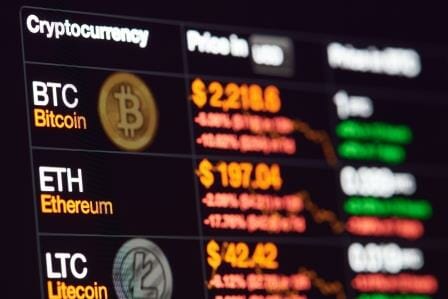
Unofficial sources reported in recent days that the cryptocurrency exchange house Binance is negotiating the acquisition of CoinMarketCap (CMC). The latter is an information service that is dedicated to tracking the cryptocurrency market in real-time.

People who heard the conversations between the two companies told digital media that the cryptocurrency exchange house would be willing to pay up to USD 400 million for the transaction, which could already be in its final stages. Neither Binance nor CoinMarketCap has confirmed or denied the information, but they could be announcing it within a few days.

According to CoinMarketCap, Malta-based cryptocurrency exchange house Binance has reported the largest volume in the cryptocurrency ecosystem, which makes the potential acquisition relevant. The company led by Changpeng Zhao has a weekly volume of more than USD 22 billion. If the negotiation takes place, it would be one of the most significant transactions within the cryptocurrency industry.

The Block reported that the potential acquisition would be related to statements that Zhao made in January of this year. At that time, he disclosed that Binance was managing two acquisitions, of which he said to be very excited as they would have a significant impact. CoinMarketCap’s ability to generate a significant amount of web traffic would be driving its influence.

Larry Cermak, Research Director at The Block, referred to the potential purchase through his Twitter account. He said that he does not know how Binance is going to deal with the obvious conflict of interest. He added that CoinMarketCap will not continue to be impartial, even though they do not have a good reputation anymore.

Although CoinMarketCap is one of the most popular crypto market tracking services, it has also received questioning. It could be reflecting false figures as a result of possible manipulation by exchange houses. The company itself admitted having incurred those faults and said that it would adopt new measures. In this way, they seek to provide their users with more accurate information about what is occurring in the market.

To encourage greater transparency, CoinMarketCap called, in May 2019, for exchange houses and cryptocurrency-related projects to disseminate reliable and real-time data on their exchanges and order books, among others. Even in November of last year, the company announced that it would apply new liquidity-based metrics to counter the practice of “inflating” reported volumes that startups do.

Among other options that operators have to track the crypto market are the services of OpenMarketCap, Messari, CoinGecko, LiveCoinWatch, and CoinCheckup. Of course, this negotiation with Binance might offer some opportunities to change how OpenMarketCap has been doing its work.

In this way, this service would become a more reliable source of information for those interested in knowing the present situation of the cryptocurrency market.

By Willmen Blanco

How to Get Started in Cryptocurrency Trading during Coronavirus Quarantine

Cryptocurrency trading opens doors to potential financial independence. It is essential to assess the risks and analyze the best opportunities for investment.

Cryptocurrency trading is a risky profession, but it can also be very rewarding economically and professionally for traders who decide to jump into the cryptocurrency market. However, no one learns this activity overnight, since it requires enough time, patience and dedication from the trader.

Unlike other professions, a cryptocurrency trader must pay his or her mistakes with money, hence the risks of trading without proper knowledge. On average, professional traders need up to four years to refine all their techniques and get used to the sharp fluctuations in the cryptocurrency market.

For many traders, the problem is not to open a transaction and win it, but to maintain consistency for weeks, months or years. Properly conducted cryptocurrency trading during the coronavirus quarantine could open the doors to financial independence, which is seen as one of its strengths.

Education and Training

According to experts, during the initial learning phase, a cryptocurrency trader can spend between 12 and 14 hours per day studying the markets. In this unpredictable profession, it is impossible to know what will happen to the price of cryptocurrencies, so traders try to study indicators to put the odds in their favor.

Cryptocurrency traders need to know what lies behind a cryptocurrency project and what its strengths and weaknesses are. Besides, they must be familiar with the natural volatility of the market, know how to read metrics and learn the latest news both on the crypto industry and the international economy.

In this phase, the operator must be aware of the different types of exchanges, their security protocols, and reputation in the crypto ecosystem, as well as the fees that they charge per transaction. The idea is to handle as much information as possible to start making sensible decisions.

Simulated Cryptocurrency Trading

Currently, a large percentage of exchanges provide the online demonstration service to simulate trading directly on the screen instead of in a notebook. With this method, cryptocurrency trading enthusiasts can learn the basics and the operation of the platform, to then start defining their strategies.

The objectives of simulated cryptocurrency trading are not to risk real money unnecessarily and to adapt to the real conditions of exchanges. The use of fictitious capital is something important to take into account to avoid generating pressure in the event of a possible loss.

Prepare for Losses

According to Spanish trader @inmortalcrypto, money losses will occur during the career of a cryptocurrency trading enthusiast. In the beginning, they are more common because the trader is in a learning process. The operator clarifies that cryptocurrency trading does not earn large amounts of money in a short time.

He recommends that enthusiasts be prepared for losses, since mistakes happen more often at the beginning, costing capital. In this phase, it is logical and normal that little experience leads them to make bad decisions, but they will also have winning streaks as they progress.

When traders make a bad decision, they should cut the loss as soon as possible and take note of what happened. This may not be pleasant to hear, but a trader can be wrong, especially in the cryptocurrency market, where fluctuations can go from 1% to 100% in a few hours.

Protection of Funds

Those who start trading cryptocurrencies during the coronavirus quarantine should not leave the funds obtained through transactions in exchanges. They should withdraw the funds to cold wallets for a better safeguard since hackers can attack this type of platform and steal funds from users and the exchange itself.

If traders do not have control over their cryptocoins with their private keys, then the cryptocoins are not theirs. Third parties can manage them for other less transparent interests in the community. Just as decentralization and transparency are encouraged in the ecosystem, traders are responsible for managing their funds, not intermediaries such as cryptocurrency exchanges.

By Alexander Salazar

Millennials to Invest Almost USD 1 Trillion in Bitcoin, According to Report

A Kraken study indicates that the price of BTC could reach USD 350,000 by 2044. Millennials and Generation X would inherit nearly USD 70 billion from the previous generation.

The baby boomer generation (those born in the 1950s) will transfer a huge amount of money to the millennial generation (those born between 1981 and 1996). That inheritance could cause the latter to drive the price of Bitcoin exponentially in the years to come.

The exchange Kraken recently conducted a study titled “How the great transfer of wealth will fuel the great adoption of Bitcoin.” According to this document, the Millennials in the USA could invest about USD 971,000 million in Bitcoin in the next 25 years. They would start from about USD 70 billion that the baby boomer generation would transfer to them as an inheritance.

The firm Coldwell Banker recently did another study, which also predicts that millennials will receive up to USD 68 billion as inheritance over the next 25 years. This will lead them to become one of the wealthiest social groups, despite having grown up in turbulent times that have witnessed various global economic recessions.

In this regard, Kraken states on its corporate blog that, if this transfer occurs, the implicit price of BTC could be USD 350,000 by 2044. The exchange adds that, even if the previous projections fall short, without 1% of the money from millennials and Generation X, the price of BTC could reach USD 70,000 that year.

Blockchain Capital conducted a study in 2019, which reports what a group of people said regarding BTC. An estimate of 42% of the participants in a survey, between 18 and 34 years old, stated that they most likely will buy Bitcoin in the next 5 years. Only 8% of those who were 65 years old agreed with that statement.

In that sense, the firm Charles Schwab did a study that ranks Grayscale Bitcoin Trust No. 5 among the main companies whose stock shares millenials purchase. Those companies include Facebook, Netflix, Disney, Tesla, Alibaba, and Apple, among others.

International Internet-based market research and data analysis firm, YouGov, made a survey where the participants expressed their opinion on cryptocurrencies. Cryptocurrencies will become a widely accepted payment method by 2030, according to 55% of Millennials and 44% of Generation X people (those born between 1961 and 1979).

Kraken cites several reasons why millennials are more likely to adopt Bitcoin than other generations. They explain that this generation opts for transparency and mobility, loves technology, likes to share information collectively, and is suspicious of banking institutions.

For its part, generation X tends to buy BTC because they grew up surrounded by computers. They are also suspicious of banks, they do not consider themselves conservative, and they value the personal independence that technological tools can provide.

Together, these generations would drive Bitcoin’s price and capitalization to unusual levels, which future generations will recognize as “the great Bitcoin adoption”, according to Kraken. With a similar title, they refer to the transfer of money between generations that will occur in the next 25 years.

Kraken believes that this growth could lead to a greater change in financial investment trends. Bitcoin is the most prominent cryptocurrency regarding this investment. Those generations more in line with its fundamental characteristics will receive this transfer of this money.

The exchange also states that many still consider Bitcoin a very complicated tool to use. However, the number of existing wallets indicates that its adoption curve is more accelerated than Internet adoption. Therefore, its technological development will progressively improve and will not present adoption problems.

By Alexander Salazar

Hotel Tamanaco Intercontinental in Venezuela Accepts Cryptocurrencies as Payment

Cryptobuyer announced the installation of a special point of sale that will allow the Hotel Tamanaco Intercontinental to accept payments in cryptocurrencies.

Since last Friday, March 6th, the Hotel Tamanaco Intercontinental reported that it enabled a system that will allow them to receive payments in cryptocurrencies. The luxurious hotel located in the city of Caracas, Venezuela, hopes to expand its services with this new payment method available to national and international users.

Through the official twitter account of Cryptobuyer, a company specialized in providing crypto services; its incorporation with the prestigious hotel company was announced.

In this way, the Hotel Tamanaco Internacional enabled a special point of sale for these assets that will run through Cryptobuyer. Until now, the cryptocurrencies that the hotel will accept for its services are Litecoin (LTC), Tether (USDT), Dash (DASH), Binance Coin (BNB), and Bitcoin (BTC).

Cryptobuyer highlighted its efforts to expand its client portfolio, as well as to improve its services in the Latin American country.

“We are pleased to announce our commercial alliance with @ICTamanaco, where today you can enjoy its facilities by paying with #cryptocurrencies through #CryptobuyerPay. This alliance reinforces our commitment to #Venezuela @InterConHotels”.

Cryptobuyer is a company that offers payment services and commercial facilities to companies that seek to implement cryptocurrencies to their businesses. The Panama-based company has already important commercial agreements with other companies in Venezuela.

The main customer in the country is Burger King, the renowned fast-food chain. Besides, Cryptobuyer has a large number of customers throughout the country. According to Jorge Luis Farías, CEO of Cryptobuyer, the client portfolio in Venezuela reaches more than 400 commercial establishments.

The company is present in other Latin American countries such as Colombia, Argentina, and Panama. They hope to expand their businesses in the coming years.

One of the advantages that make the system implemented by Cryptobuyer so attractive for customers is the way of establishing these alliances since the system is completely free for companies that have joined the solution.

By introducing its payment platform into the business, Cryptobuyer receives payments in any of the indicated cryptocurrencies and, in less than 48 hours, the client receives the money in fiat currency in his account. These types of alternatives prove to be very important for companies that live with the economic difficulties of the countries where they operate. Argentina and Venezuela are an example of this.

It is important to note that cryptobuyers perform these payments not only using a point of sale but also through smartphone.

Hence, small entrepreneurs or freelancers can also use the platform to accept cryptocurrencies as payment and receive traditional money in their accounts. This solution would avoid the use of exchange houses or other financial intermediaries.

By the end of January 2020, another important hotel chain, the Eurobuilding Hotel, announced it would be accepting cryptocurrencies as a payment method. Thus, the Hotel Tamanaco Intercontinental is not the first one to use the payment gateway offered by Cryptobuyer in Venezuela.

According to LocalBitcoins data, Venezuela ranks first on the list of countries that use cryptocurrencies for commercialization. However, they clarify that this does not necessarily mean a great impact on the global digital currency markets. Maybe, the use of these platforms is only an alternative to survive the serious crisis the country is facing.

By María Rodríguez

Changes in EOS Governance Approved to Finance New Projects

The EOS Worker Proposal System (WPS) is a method similar to that implemented by Dash. The initiative got the first of four possible approvals for its implementation.

A new scheme to finance EOS-related projects received the first of four possible approvals from 34 block producers. The acceptance comes amid a series of criticisms since the new mechanism would not have an effective method to measure the risks of the initiatives.

Block producers EOS Nation and Attic Labs jointly introduced the EOS Worker Proposal System (WPS). Of the 21 major block producers, 19 voted in favor of the proposal, the minimum being 15 votes.

EOS Nation reported that the voting represented token holders’ will and they are now moving forward with the next steps to implement WPS in EOS. The second step that the block producer discusses is approving the transfer of 50,000 EOS tokens from eosio.names to eosio.wps. The third phase would be to implement the WPS smart contract in eosio.wps, to finally initialize the new governance system.

The rules codified within WPS smart contracts govern this decentralized voting and distribution mechanism, allowing any EOS account to propose a budget for their specific project, according to EOS Nation. They added that block producers chosen by token holders will be in charge of voting on them. They explained that each proposal that passes receives a direct payment from eosio.wps to the EOS account that proposed the work.

Those wishing to submit a draft proposal must pay a non-refundable commission of 100 EOS to eosio.wps. The maximum budget will be 25,000 EOS, which will be available for each 30-day voting period. The funding for eosio.wps comes from fees accrued on the eosio.names and eosio.ramfee accounts.

For a project to receive financing, it must undergo the planned multi-signature (MSIG) approval process. It is a four-stage system, like the one implemented for the approval of these changes, in which at least 15 of 21 of the main block producers must give their approval. If the proposals are scalable or expandable, then they must receive at least 20 positive votes.

Criticism of Changes

Before receiving approval, Brendan Blumer, CEO of Block.one, the company behind EOS and developer of the EOSIO protocol, was concerned about the possible effects of the mechanism on the network.

According to Blumer, socially authorizing block producers to direct token holders’ funds to projects without a clear or measurable return on value is risky and can open the door to corruption and external scrutiny. He believes that decentralized financing is new and exciting and is in favor of specific projects that explore how such models can compete with legacy models. However, he thinks that their lack of sustainability, applicability and measurable returns can lead them to a bad prognosis.

The mechanism to be incorporated into EOS governance is similar to the one that Dash, jointly with the Dash Investment Foundation (DIF), approved last year. The DIF belongs to the Dash network, in which the community votes through the master nodes in favor or against the proposals submitted in the DIF.

At the time of writing this article, the price of EOS, the cryptocurrency associated with the project, was USD 2.25 per unit, with a negative variation of 1.24% in the last 24 hours, according to data from LiveCoinWatch.

By Alexander Salazar