How AMREC is Building a Better Blockchain Community

     A new venture with the aim of making a very large impact on society has been launched. AMREC (American Renewable Energy Corporation),

“a cutting edge renewable energy innovator”,

AMREC is focused on developing and implementing affordable, clean energy that’s not dependent on any subsidies. The AMREC team unveiled the full scope of the company’s innovations and their applications back in April at the Blockchain Nation Conference in Miami.

The CEO shared some of the reasons he’s most excited to be involved with AMREC and some of the other ways he’s continuing his mission to “build a better blockchain community.”

“AMREC will provide safe, reliable energy, worldwide at a fraction of the cost of traditional energy sources. Not only will this clean energy make blockchain mining cheaper and more reliable, but AMREC will also utilize blockchain technology to keep track of license distribution, logs of sales and services. This will make it the first truly transparent public company,” explained The CEO. “After AMREC’s planned IPO, every investor will be able to go online and see what’s happening with every single dollar, as well as every component of the company from wind mill function to inventory or accounting.”

The Answer is Blowing in the Wind

While the company plans to eventually expand to multiple sources of clean, renewable energy, their current focus is developing the safest, most efficient and cost-effective, wind energy. According to the CEO, AMREC has perfected the use of the vertical-axis wind turbine (VAWT), a technology developed by the French aeronautical engineer George Jean Marie Darrieus. AMREC has packaged the Darrieus turbine for market use and plans to start the process of taking the company public within the next six months.
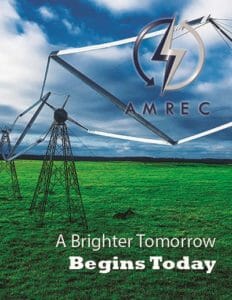
VAWTs are a type of wind turbine where the main rotor shaft is set transverse to the wind (but not necessarily vertically) while the main components are located at the base of the turbine. The Darrieus wind turbine consists of a number of curved aero foil blades mounted
on a vertical rotating shaft or framework. The cost of production of these wind turbines is reportedly far lower than that of other available wind turbines. “Our systems are closer to the ground with a simplified motorized head that enables the most cost-effective production and operation,” said The CEO. “Our engineers have found the best configuration of height, size, and position to maximize the revenue potential of the wind. If I gave you the numbers, you wouldn’t believe them. I think people will be very impressed, at the figures we announced at the Blockchain Nation Convention in April.”

Protecting the Grid

Another significant problem that AMREC has addressed is to provide a source of electromagnetic pulse (EMP) safe energy.

“With an EMP attack, the whole society could go back to the stone age in an instant. It’s a relatively simply problem to solve, but because of the high cost of electricity, it’s not feasible for energy companies to create the shields needed to provide EMP protection,”

explained The CEO. Super EMPs are nuclear warheads designed to explode in the atmosphere, generating high-frequency electromagnetic pulses that destroy electronic devices, according to a report by the Commission to Assess the Threat of EMP Attacks. Testifying before a Congressional Homeland Security subcommittee in October 2017, Peter Vincent Pry, a nuclear strategist formerly with the CIA, warned that millions of lives could be lost through mass starvation, disease and societal collapse if there was ever an EMP attack by North Korea. This report recommended that the government “protect elements of the national electric grids, the keystone critical infrastructure upon which all other critical infrastructures depend.” And according to The CEO, AMREC has found a cost-effective way to shield their wind turbines from EMP damage in the case of such an attack.

Roadmap To Success

With AMREC, there is no coin involved, but each windmill turbine will have a license that can be bought and sold. In the future, buying the license will be a way to invest in the company and raise money for its development. The company plans to sell its clean energy to power companies to help them provide the amount of clean energy required by local legislation without subsidies. They also plan to help solve a big challenge for cryptocurrency miners since mining has increased the demand for electricity. Because of the rising cost of electricity, a lot of miners are not able to buy all the electricity they need from power companies. “With our technology, we will provide electricity to the grid, and also offer electricity directly to miners at a substantially lower price. That will mean greater profit margin for the miners.”

AMREC currently has several functioning wind turbines in Europe. They are in the process of confirming their calculations for the US, Caribbean, and Latin American markets.

“Within 3 or 4 months, we expect to go into multiple markets. When we scale up, it’s going to be a very large operation,” explained Vilenchik. The company’s development plan also include investment in the future of clean energy technologies with scholarships and research grants. “We are investing in innovative individuals and R&D of up and coming clean energy scientists who don’t have opportunities to get financed otherwise,” said Vilenchik proudly.

As far as competitive pressures go, The CEO acknowledges that the supply of materials such as steel will be the main hurdle for scaling the new company. Otherwise he feels very confident about the business model and its chances for success. The CEO said that the AMREC team includes blockchain industry leaders and high-ranking government officers, the names of which were announced at the Blockchain Nation Convention in April.

The CEO would only reveal that Jose Gomez, the former Chief of Staff to the Venezuelan government, is AMREC’s Director of Latin American Operations. He also spoke at the Miami Convention. “When we publish all the names of the board members, you will be very impressed,” said The CEO.

Bringing People Together Across Blockchain Initiatives

When asked whether taking his company public is counter to the “decentralized” doctrine of the blockchain community, The CEO explained that it was quite the opposite. “The whole idea of blockchain is a way to keep people honest and to provide transparency. By creating our infrastructure with blockchain, investors will always have control and we will be most able to deliver the product to the market.

Filing with the government does not make you a traitor to the ideals of the blockchain community; it just makes you compliant to the real world. Many ICOs are failing because they are trying to create something that can’t be accomplished without proper government licenses.”

AMREC seems to be a good example of how a blockchain business can integrate effectively with government regulation. The CEO believes that the success of the blockchain community depends on education and communication across sectors. And this is why as the owner of Crypto World Journal, he has spearheaded the Blockchain Nation Conventions. “It’s not just a whole bunch of technology fans singing kumbaya and promoting their ICOs. These events enable the general public to learn, and for industry and government leaders to dialogue. When the blockchain community can understand the concerns of the government and the government can understand the problems that the blockchain community is trying to solve, they can align on how to work together most effectively,” said The CEO.

“The speaker line up was just amazing. I’m so proud to know all of these people, call them friends, and have all of them be part of these event.”

Blockchain Nation Miami took place April 25-26th at the Kovens Conference Center in Miami. Notable speakers included: “The People’s Shark”, Daymond John; industry legend, John McAfee; pharmaceutical trailblazer and investor, Cindy Whitehead; Frank Abagnale, the authority on forgery and document security and inspiration for the movie Catch Me if You Can; Andrew Filipowski, the successful high-tech entrepreneur and CEO of Fluree; Ronnie Moas, Founder and Director of Research at Standpoint Research; and Jim Rogers, Chairman of Rogers Holding and Beeland Interests Inc., who The CEO describes as “the person that the government goes to when planning financial systems.”

For more information about Blockchain Nation events visit www.bcnation.com.

To learn more about AMREC, look for the team at Blockchain Nation events around the world or visit www.AMREC.com.



Blockstack – First Ecosystem Wide Universal Decentralized App Store

Yesterday, Blockstack Public Benefit Corporation (Blockstack PBC) released the first “ecosystem-wide, universal” Dapp Store, (a service like Apple’s Appstore or Android’s Playstore), a platform for the exposure and easy access of decentralized apps, with more than 150 Dapps to date.

“We believe it is critical to drive everyday users to Dapps that are ready for widespread adoption. That’s why we’re announcing the first ecosystem-wide, universal Dapp Store”

Dapps have seen an increase in number in the lasts years as more developers demonstrate interest in the benefits of blockchain technology and encryption. This fast-growing app ecosystem, aids new users in finding Dapps that suit their needs and preferences. According to the official announcement, the Blockstack Dapp Store is

“a discovery tool for decentralized apps built on Blockstack, Ethereum, EOS, IPFS, Steem, and more … serving as an aggregator of usable Dapps for gaming, social networking, productivity, and financial services.”

Apps, already popular in the community like Stealthy, Graphite, Peepeth or DTube are featured. Even though popular in the circles of early-adopters many of these apps are in beta or alpha phase and may require you to pay processing fees for the network. Currently, Dapps are accessed through a myriad of different channels, creating a bottleneck for people wanting to seamlessly discover the best of what the decentralized internet has to offer. The Dapp Store not only addresses the “discoverability” problem for users, but facilitates a way for developers to feature their Dapps in one place.

With a nice, minimal looking interface, the Dapp Store arranges the apps according to their category as well as the blockchain protocol it supports, such as Ethereum or Steem. According to their announcement, for Blockstack, to be considered as a Dapp you must fit into the following criteria:
     -Do customers own their network identity? Can anyone else revoke that identity?
     -Is private user data encrypted with user-owned keys?
     -Is customer data stored on decentralized networks with reconfigurable APIs?
     -Is the app open source? Can community members contribute or fork the software?
     -Is the app publishable and host-able by others or only a single company?
     -Is the app running client-side or on a server?
     -Does the app limit or clearly communicate the scope of data logging?

It is clear that initiatives like this one are necessary for a healthy decentralized apps community and ecosystem. Sites that conglomerate useful applications, and facilitate the discovery of blockchain services for enthusiast of this technology.


by Samuel Larreal

“We Want Our Own Cryptocurrency” – Bank of England

In a recent statement, the Director of the Bank of England (BOE), Mark Carney,
announced his support for the creation of a cryptocurrency backed by the banking
entity.

This announcement was communicated during the RiksBank conference in Switzerland. Although this potential BOE cryptocurrency will not be issued any time soon, it will
establish the presence of the United Kingdom as part of the crypto-community and may generate more reliable means for electronic transfers.

However, before taking the first steps, Carney emphasized the need to conduct a study of the current market terrain. The economy in the United Kingdom remains in a state of readjustment, so the appearance of new digital financial currency, such as cryptocurrencies, may help the region’s economic growth. According to Carney,

“A more disordered transition, or a final state materially different from our
assumption, will have implications for monetary policy. Although the exact policy
response can’t be predicted in advance, viewers know from our track record that,
in exceptional circumstances, both of us are willing to tolerate some deviation
from target inflation for a limited period and there are limits to that tolerance “

Despite the present problems, Carney remains optimistic about what a BOE cryptocurrency will bring and how it will benefit banking entities.

Recently, investigations have been launched into around 20 companies associated with
cryptocurrencies. These investigations are being carried out by the Financial Conduct
Authority (FCA), and are looking into the trends of these businesses who may have been
reported as illegal, after ignoring the legal registration process.


by Samuel Paz

UK Investigates Cryptocurrency Businesses – Financial Regulatory Compliance

     United Kingdom authorities have opened a 24 investigation into cryptocurrency businesses over financial regulatory compliance issues.

As the local media outlet, CityWire, reported on May 25th, responding to a freedom of information request, UK’s Financial Conduct Authority (FCA) opened 24 investigations into cryptocurrency businesses over financial regulatory compliance. The FCA also confirmed it had opened seven whistleblower reports since the start of the year.

While the FCA did not specify what businesses are being investigated, a CityWire source stated that the investigations were being made in order to

“determine whether they might be carrying on regulated activities that require FCA authorization.”

Addressing any possible consequences of its own investigation, the FCA meanwhile appeared to hint that it would take action according to the seriousness of any offending business, without mentioning which parameters it would use to judge activities.

“If we conclude that they are, then we may investigate and take action, identifying and determining the most serious matters which pose the greatest risk to consumers.”

Said FCA to CityWire claiming that the investigation’s priority is consumer protection.

“The actions the FCA may take ranges from issuing an alert to consumers via the FCA website to warn them about a particular individual, activity or firm, to launching civil court action to stop activity and freeze assets.”

Said FCA to the local news outlet. It also clarified in its response, that not all cryptoassets are within its regulatory perimeter.


by Samuel Larreal

Blockchain Communication for New Internet – MIT

     Blockchain networks must “talk to each other” to become the new internet, says MIT experts.

On May 24th the MIT Technology Review published an article by Mike Orcutt, their in-house, cryptocurrency and blockchain specialiist, where he explained the need for blockchains to be connected to each other in order to become what the internet is today for the financial field and other industries in general. As Orcutt explained, blockchain has been compared to the early internet an infinite number of times, and according to many enthusiasts in the field, it could have a similar effect on our society, opening the door to a

“new global financial system that works like the internet, except instead of moving around little packets of information, it moves money”.

However, currently, blockchain technology has significant obstacles to avoid in order to accomplish that prognostication, quoting Orcutt,

“blockchains don’t talk to each other.”

To Orcutt, new blockchain projects usually perform like a “petri dish full of bacteria”, multiplying and developing new ways to archive their objectives, but not “headed toward any kind of higher-order organism”.

Before the internet in the 1960s and 1970s, the scene seemed similar to the current state of blockchain technology, as there were several separate technical approaches to constructing computer networks, explained Thomas Hardjono, part of MIT’s Connection Science Program.

“the key to moving things forward lies in figuring out how to make these individual systems work together.”

Says Hardjono.

In the 1970s and 1980s, the transmission control protocol (TCP) and the internet protocol (IP) which have now become the bedrock of today’s internet, was developed, thanks to a combination of academic and US military research. This led to the construction of a common infrastructure that allowed individual networks to share resources, especially in the event that one of the networks was attacked. Systems like this allow networks (or potentially, blockchains) to transfer data to each other immediately.  This is necessary to add

“risk and technical liabilities into your economic system.”

Says Hardjono.


by Samuel Larreal

ICO’s Legal In South Korea

     The South Korean Government is planning to legalize Initial Coin Offerings (ICO’s) within the region.

The South Korean National Assembly has officially passed a proposal to allow domestic ICO’s, after imposing a total ban on ICOs in September 2017 according to local news media today.

Business Korea recently reported that a national assembly committee dedicated to the study of blockchain technology and cryptocurrency suggested a

“legislative and policy proposal of recommendation to allow ICO’s under the conditions of investor protection provisions preparation”,

seeking to enhance a legal “basis” of cryptocurrency in the country.

“We need to form a task force including private experts in order to improve transparency of cryptocurrency trading and establish a healthy trade order, we will also establish a legal basis for cryptocurrency trading, including permission of ICOs, through the National Assembly Standing Committee”

said the Special Committee for the Fourth Industrial Revolution, in an official statement on May 28th. The committee communicated their concerns on the government decisions regarding this cryptocurrency and blockchain field.

The department accused the administration of neglecting its duty to respond to blockchain application expansion, which was selected as a core subject in the regulatory reform sector. They urged the administration to

“consider setting up a new committee and building governance systems at its level in a bid to systematically make blockchain policy and efficiently provide industrial support.”

Over the course of the year, experts and influential figures of the technology industry, have  called on regulators to embrace innovation, while maintaining the standards of security for investors and consumers, in a manner that continues to mature this growing industry.


by Samuel Larreal