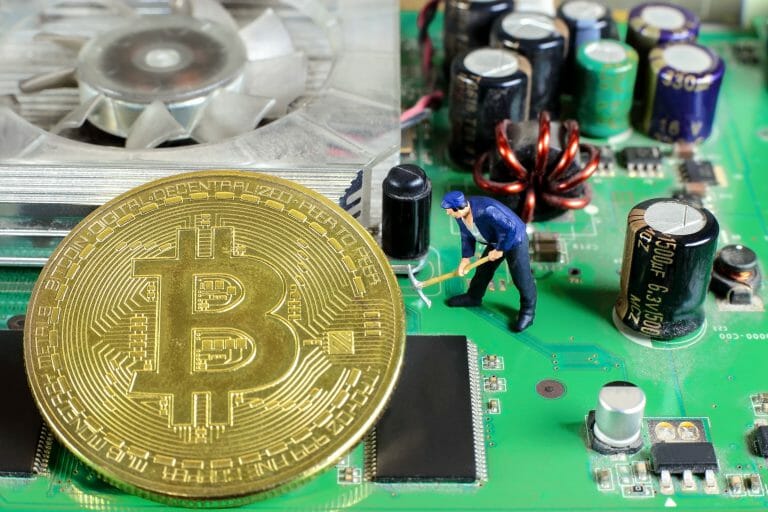
Bitcoin Mining Represents a Threat to the Ecological Goals that China Has Set, According to a Study

China’s cheap energy allows old mining equipment to operate, contradicting the argument for the evolution of equipment efficiency. Some receive the study with skepticism because they consider that it suffers from a series of limitations on the data that it presents.

China and the former USSR adequately managed the protection of the environment within their economies. In contrast to the West, these countries were able to regulate carbon emissions and accurately set goals. That was before Bitcoin mining emerged to become a threat to China’s green goals.

A study by Nature Communications warns about the contaminating potential behind the main cryptocurrency on the market. Although there have been many debates on this topic for years, there seem to be clues to support the publication in question.

Enthusiasts usually defend the mining business by arguing the evolutionary potential of the equipment. Since mining has expanded to various countries, manufacturers have had to adapt their machines to more demanding conditions of electricity rates. For that reason, ASICs have become increasingly energy-efficient.

Bitcoin Mining Threatens China’s Environmental Goals

It is striking that Bitcoin mining is threatening the goals of a superpower with a planned economy. The low cost of electricity in that Asian country allows keeping old mining equipment operational.

This contradicts the argument for the evolution of equipment efficiency. China concentrates more than half of the world’s farms, most of which operate with high-consumption equipment.

All cryptocurrencies mineable with the Proof-of-Work (PoW) protocol have the same nature of consumption as Bitcoin. According to the study, Bitcoin mining is seriously threatening China’s goals of becoming an environmentally friendly nation.

They explain that carbon emissions will reach worrying levels if no intervention regulates the growth of the business. “Energy consumption is increasing along with carbon emissions from mining. This situation could erode environmental efforts in the world,” they say.

China Must Face a Rival Threatening Its Plans

Beijing has set goals that Bitcoin mining is threatening, which suggests a potential crash. Chinese President Xi Jinping predicted that the country will have controlled carbon emissions by 2030. He also assured that China would be carbon neutral by 2060.

However, Bitcoin mining seems to be running counter to this view of the Chinese premier. The energy consumption of this business is 128.84 terawatt-hours per year, equivalent to the consumption of countries such as Ukraine or Argentina.

The pace of growth of the business suggests that the consumption will be 296.59 terawatt-hours per year by 2024, in China alone. This would equal 130.50 million metric tons of carbon, according to the study. At that time, the energy consumption would be equivalent to that of Saudi Arabia or Italy.

The Study “Leaves Much to Be Desired” Due to Data Limitations

The Nature study seems to be well-founded, but some have received it with skepticism. For example, Nic Carter from Castle Island Ventures considers that it suffers from a series of limitations on the data that it presents. He said on his Twitter account that the publication “leaves much to be desired.”

Carter believes that the study is not able to distinguish the types of energy used in Bitcoin mining.

Aside from the debate between environmental and Bitcoin advocates aside, China is already taking action. For example, the authorities are intensifying their hostile position against Bitcoin mining in the Inner Mongolia province.

By Alexander Salazar

The US Department of the Treasury Was Not Taking Action against Bitcoin and Other Cryptocurrencies, According to Kristin Smith

The fall in the price of Bitcoin seems to be due to rumors about the Treasury’s measures against money laundering related to cryptocurrencies. Smith said that Yellen must understand the value of cryptocurrencies rather than think that they primarily contribute to funding crime.

Blockchain Association CEO Kristin Smith recently dismissed rumors about the US Treasury Department. Twitter users said that this agency was on the verge of taking action against Bitcoin (BTC) and other cryptocurrencies.

Those unconfirmed rumors led the cryptocurrency market to crash in recent days. They said that the Treasury Department could be working on stronger regulations for the sector. The excuse would be that they want to prevent money laundering.

For that reason, Fundstrat’s Leeor Shimron said that “there have been a lot of rumors and speculations about the recent market crash.”

Likewise, IG Markets analyst Diego Morín stressed that Bitcoin has lost up to 14% after those speculations. According to the rumors, the US Treasury could be seeking to fight money laundering related to cryptocurrencies.

Kristin Smith Dismisses Rumors about Anti-Bitcoin Measures

The price of Bitcoin has skyrocketed this year, but its sharp drop seems to be the result of unconfirmed rumors. Twitter users said that the Treasury Department planned to take action against money laundering schemes related to cryptocurrencies.

In an interview on the CNBC television channel, Kristin Smith debunked the reports. She claimed that charging money laundering companies was the exclusive competence of the Justice Department.

In a Twitter thread, Smith said that there has been enormous confusion about alleged regulation and its application to cryptocurrencies. Likewise, she explained that it is necessary to be clear about who is in charge of doing things. She stated that the Secretary of the Treasury is not involved in the execution decisions but career professionals in the Treasury.”

The Treasury Has Not Been Analyzing Cryptocurrency Regulation

Smith stated that “Yellen has not created a Task Force to analyze the regulation on cryptocurrencies. However, this situation could change in the future.”

She warns that it is necessary to “be careful with tweets from suspicious accounts. Instead, we must know the real financial system bodies, which can shape the regulatory game.”

According to Smith, events like Coinbase’s listing on Nasdaq provide evidence about the growing validation of the cryptocurrency market. For that reason, the Washington authorities can hardly ignore such a phenomenon.

Blockchain Association Seeks to Talk about Cryptocurrency Regulations

The cryptocurrency advocacy group Blockchain Association is lobbying key figures in the Biden administration. They want there to be a more favorable regulation on cryptocurrencies.

Kristin Smith said that the group is still in the process of scheduling meetings with senior White House officials. Among them would be the Secretary of the Treasury, Janet Yellen.

Smith cited Yellen’s comments that the main utility of cryptocurrencies is “illicit financing.” She said that the association was seeking to help the Treasury chief “understand the value of cryptocurrency networks.”

At the time of writing this article, Bitcoin is trading above USD 55,000, according to data from CoinGecko.

By Alexander Salazar

Disaster Girl Meme Turned Into NFT Format and Sold at Auction for More than 300 Thousand Dollars

The “Disaster Girl” meme was on sale on April 17, 2021, by a music studio. Also, in South Korea, another meme received a significant sum of money.

NFTs or non-fungible tokens have become a new sensation in internet sales. Its scope has now reached the memes, which are currently on sale in that format.

On the Foundation App platform @DisasterGirl put on sale a popular meme that says, “When disaster strikes… She’s there!” The NFT reached the company on April 17, 2021, by the Dubai Company 3F Music, which paid 180 ether (ETH), equivalent to USD 388,976 at the current exchange rate.

This company, which owns a large music studio, has also acquired other NFTs of lesser value than that of “Disaster Girl”, as observed in its profile on the marketplace. Among them are “Future Proof” (for 4.4 ETH), “The Vault” (for 2.0 ETH) and “Cyrus the Great” (for 1.5 ETH).

The “disaster girl” meme goes with a brief description that tells how the girl came to be the protagonist of the renowned image. In the narrative, there is an explanation for the girl’s name, which is Zoe Roth.

She became famous back in 2005 when her father took her photo in front of a burning house. He asked her to smile, and she did, although the result was a burning house and a girl with a “malevolent smile” posing in front of such tragedy.

Her face became a meme in three years, and she adopted the nickname “disaster girl.” It wasn’t until 2008 that her father submitted the photo to a magazine photography contest and won the extra chance to feature on its cover. It was from that moment that the girl’s face went viral.

That “almost evil” smile in front of the burning house awoke the interest of many internet users, who cut out his face and used Photoshop to put it on many other tragic and funny situations, even historical events.

 Memes in NFT Format are Also for Sale through Auctions in South Korea

South Korea is also a leader when it comes to the sale of memes in NFT format. The Mari Kim Foundation launched what it called “10 Seconds of Animated Works of Art,” for which it raised 600 million won (about the US $ 537,837), equivalent to 288 ETH.

The information came to public light through a press release, states that the sale came to fruition through the Pica Project with an initial price of 50 million won (about US $ 44,834) and was bought by a Korean bidder “after fierce competition.”

The bid price was more than eleven times higher than the initial bid and was the highest selling price for an artwork by Mari Kim. It was four times higher than the cost of his 2019 “Tree of Life,” which sold for 150 million won in 2020.

By: Jenson Nuñez

US Congressman Believes that Ignoring Bitcoin Could Be a Serious Mistake

Congressman Kevin McCarthy highlighted how concerning it is that the United States is ignoring Bitcoin (BTC). He says that it is relevant to learn more about it as other countries like China are moving forward.

US Republican leader Kevin McCarthy was recently in an interview on CNBC television. The congressman warned about how dangerous the fact that the United States ignores Bitcoin (BTC) can be.

McCarthy serves California’s 23rd District and is currently the Republican leader in the US House of Representatives.

In the interview, the congressman spoke about the Secretary of the Treasury, Janet Yellen, and the President of the FED, Jerome Powell. Regarding whether they “had good knowledge of digital currencies,” he stated that both officials tried to ignore Bitcoin to make it disappear.

McCarthy Says that Ignoring Bitcoin Will Not Make It Go Away

The President of the FED and the Secretary of the US Treasury have not gotten used to Bitcoin nor have they realized its potential. Powell went so far as to assure that cryptocurrencies are “vehicles for speculation.” Similarly, Janet Yellen highlighted the need to reduce the use of cryptocurrencies to combat money laundering.

However, it is a reality that the United States seems to be lagging when it comes to cryptocurrencies, especially Bitcoin.

“Since Bitcoin will be part of the future, they should not ignore it. Not only should they learn more about it, but the base should continue to grow as well. Government policy-making agencies should begin to understand what it means for the future. Other countries are moving forward, especially China,” McCarthy said.

On other occasions, there have been debates about the lack of a position on the market of cryptocurrencies, especially Bitcoin. This is particularly worrying since other countries have been making progress on these topics.

“I do not want the United States to remain behind [when it comes to cryptocurrencies]. I want the next century to be ours. For that reason, I want to look forward rather than backward, and not keep my head in the sand,” the legislator concluded.

There is Growing Interest in Bitcoin ETFs in the United States

Investment manager VanEck launched its first Bitcoin, cryptocurrency, and digital asset company ETF. According to the firm, this fund provides exposure to companies that “drive the digital transformation of the global economy.”

Canada, which has already managed to get ahead of the United States regarding the issue of Bitcoin ETF issuance, recently launched a reverse ETF. It gets that name because it allows investors to make money when Bitcoin goes down in price.

Gary Gensler recently received the ratification as the new SEC Chairman. That could be a factor for more flexibility in considering the Bitcoin ETF applications before that commission. Gensler is one of a group of new members of the SEC that people consider favorable to Bitcoin.

The speeches of this group of officials have been different from the opinions contrary to the cryptocurrency ecosystem. Far from associating Bitcoin with illicit activities, they have shown a greater understanding of the growing importance of this new technology.

By Alexander Salazar

Argentina will Host Bitfarms’ Largest Bitcoin Mining center

The company found optimal conditions in the Latin American country to set an expansion for its operations. The facilities would be operational in early 2022.

The Canadian company Bitfarms Ltd is advancing its plans to build a gigantic bitcoin (BTC) mining center in Argentina, a project it has been working on since October last year. The facility, whose exact location remains unknown, will operate 55,000 mining machines and is shaping up to be one of the firm’s largest farms.

Bitfarms reported that to achieve its goal, it has signed an eight-year power agreement with a local private company that, for the first four years, will secure 210 megawatts of electricity at a price of 0.02-kilowatt-hours.

The company estimates that 210 megawatts of electricity will be helpful to produce about 11,774 bitcoins, equivalent to approximately USD 650 million at the current price of the cryptocurrency (USD 55,000).

The one in Argentina will be the facility with the highest energy supply of the five that the company has. Its Quebec warehouses, Cowansville, Magog, Farnham, St. Hyacinthe, and Sherbrooke, consume about 69 megawatts of electricity. These figures compare to the company’s performance in 2019, a year in which they had less than 20,000 Bitcoin mining equipment.

Cheap energy from Argentina would allow Bitfarm to accomplish a mining routine at a lower cost than those generated at its Canadian facilities. In Québec, during the fourth quarter of 2020, the average price of mining a whole coin was USD 7,500, but the firm believes that, in Argentine territory, it will be able to do so for USD 4,125, with a significant savings of 45%.

Argentina is a Country that Favours Bitcoin Miners in Many Ways

Bitfarms also plans to move a considerable number of its older miners to the new data centre in Argentina. In this regard, he added that, although this equipment is less efficient than the latest generation, “the low cost of electricity and the proven reliability of these miners will prolong their economic life.”

The company’s plan is for the Argentine mining center to start operating in early 2022 and become a significant contributor to the macro target of reaching 8.0 exahash / second by the end of that year.

The favourable climate of the Latin American country will be a great ally throughout the year because it is not necessary the use expensive liquid immersion cooling to keep mining equipment operating optimally.

Based on the climatic conditions mentioned by the company in its statement, it is an assumption that Bitfarm will locate its mining center in the Patagonian region, in the south- away part of the country, the only area of ​​Argentina with a cold and constant climate throughout the year. For three years, the province of Tierra del Fuego shows itself as a potential territory for Bitcoin mining.

The building’s construction will begin soon as the company highlighted that it is in advanced conversations with an engineering services firm responsible for directing the execution of the work.

By: Jenson Nuñez

Governor in Venezuela Made a Proposal Called “Bitcoin City” for all Commercial Payments

The system would offer support in the first phase for bitcoin, Dash, and petro. The exchange CriptoLago would be part of the platform for transactions.

The governor of the Venezuelan State of Zulia, Omar Prieto, announced this Tuesday, April 20, that a plan to massify a debit card backed by cryptocurrencies is under development. The project received the name of “Bitcoin City” and set its establishment in all the businesses of the regional entity.

According to the authority, the platform would allow users to handle the card and make purchase and payments in bitcoin, Dash or petro. However, merchants will not receive the crypto assets directly but rather bolivars, the country’s national currency. An exchange would come into play in operation, which is still unknown, and would be in charge of converting and debiting the funds in the network.

 ” We are implementing this system with some important allies who call it the Bitcoin City project (…) all businesses will have this system to pay with bitcoin, Dash or petro,” said Prieto during the transmission of his radio and television program Omar at 7.

The economist also reported that the system would start its implementation on the Rafael Urdaneta Bridge. In other words, drivers who pass through the structure will be able to pay tolls using a debit card.

Bitcoin Exchange as a Joint Quest

The governor did not offer details about when the system would begin. Still, he said that a mixed capital company (public and private) would play an essential role in this implementation; which would be the cryptocurrency exchange or exchange house.

“We as an exchange house, I say “we” because it is a mixed company, we make the transfer, and we transform the bitcoin to what you are paying, you pay with bolivars, and you receive a deduction from your savings in bitcoin, petro or Dash” added the governor.

Prieto would be referring to the CriptoLago exchange located in Zulia, which is one of the exchange houses authorized by the National Superintendency of Crypto Assets and Related Activities (Sunacrip). According to a report from the Chainalysis firm, Prieto serves as the president of CriptoLago.

Currently, users of the exchange can request a debit card for payments at affiliated merchants. The instrument came to light in September 2019 in alliance with the Glufco Company. The platform could be the only active one, although the number of businesses that process payments with this system is unknown.

The exchange house itself posted a brief message on its Twitter account about the governor’s announcement. “We are ready to keep contributing to the growth of the crypto economy of our country,” said CriptoLago on the social network.

Governor Prieto has spoken in the past on different aspects of the Venezuelan bitcoin ecosystem. In May 2018, he accused the illegal mining of cryptocurrencies as the cause of the electrical failures in Zulia.

By: Jenson Nuñez