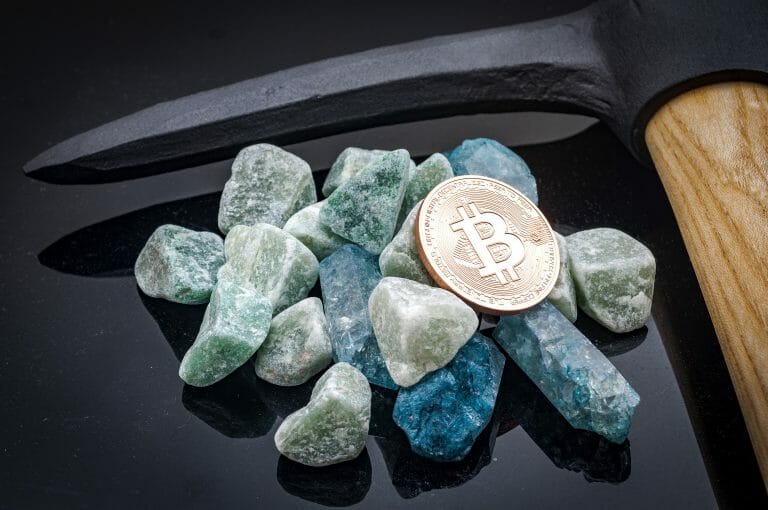
Here is What Could Happen to Bitcoin Mining in 2022

Amid challenges and optimistic forecasts, the global Bitcoin mining business is preparing for 2022. Threats that may harm that activity include some countries trying to implement regulations to seize its fruits.

Bitcoin mining has shown great strength after overcoming repressive aggression from China and must now prepare for 2022. The business seems to be going into a very positive year of growth and expansion worldwide. However, some problems can cause some headaches for this industry.

One of the obstacles to crypto asset mining is the accusations of harm to the environment. Another could be the shortage of semiconductor chips essential to create ASIC mining equipment. This shortage affects not only mining but also the automobile and cell phone industries, among others.

However, the positive points seem to outweigh the negative ones. The victory against the Chinese repression and the risk of the hash rate falling strengthens the security of the business. The growing popularity of cryptocurrencies will help make mining profitable.

Forecasts about Bitcoin Mining for 2022

The future of Bitcoin mining looks positive for 2022, as the decentralization of the business has shielded the network against external attacks. In the same way, it provides transparency as the new epicenter could be in countries with more reliable public statistics.

For example, managing this data will make it easier to determine the true environmental impact of the mining business. When Bitcoin mining concentrated in China, that was a very complex task. The criticism against this activity for alleged contamination became a thing of the past after the hash rate left that Asian country.

The impact of Bitcoin and its mining industry on the environment is undeniable, as is the transition. Mining goes from using fossil fuels to using cheaper alternative energy sources. That is essential, as miners depend on low-cost energy sources for higher profits.

The Potential of Bitcoin Mining and the Threats Against It

Bitcoin mining seems to have a lot of potential for 2022, but some threats may hurt it. Some countries will try to implement regulations on the business to seize its fruits. They may fail, but they will cause pain to mining in their attempt.

Another danger to the business is the limited supply of chips and other components. That will make it difficult to manufacture new and better mining equipment models, harming innovation in the sector.

Furthermore, oligopolies take over all the lots, which is of great concern to the crypto community. Bitcoin mining will become more elusive for small and medium-sized miners. One of the first symptoms is the large volume of advance purchases by companies like Marathon and Riot Blockchain.

Popularity and Expansion of Bitcoin Mining in 2022

The growing adoption of cryptocurrencies will make mining a more profitable business in 2022. The price of the pioneering cryptocurrency may reach significant levels, leading its capitalization to grow significantly.

The presence of Bitcoin in the commercial and financial world will allow it to play a more relevant role. As a result, the benefits for those engaged in mining will grow. The latter is a long-term trend for 2022, but it could lead to a considerable increase in Bitcoin mining.

By Alexander Salazar

Brian Armstrong Believes Many People Will Become Billionaires Thanks to Cryptocurrencies

The executive said that the first cryptocurrency on the market has never failed and will continue to thrive. Almost all financial institutions will process cryptocurrency transactions, while funds will hold crypto assets.

Coinbase CEO Brian Armstrong addressed the progress of the cryptocurrency industry so far this decade in a report. In discussing the subject, he said that an article on technology in the last ten years by Fred Wilson inspired him.

Armstrong began his report by saying that the pioneering cryptocurrency has not failed a single time. Some people doubt that Bitcoin will survive, but the executive thinks that the digital currency will thrive.

He noted that more than 379 articles prematurely declared the end of Bitcoin, but it managed to survive against all odds. In that way, it became the highest-performing asset of the decade, proving his detractors to be wrong. Armstrong said that people have learned that most great breakthroughs are ideas dismissed and ridiculed at first.

Other Important Aspects of the Cryptocurrency Space

Additionally, the summary mentions the competition that arose with creating a growing number of crypto assets. That situation fueled innovation within the industry and attracted the attention of investors.

Although there were bubbles and drops in the prices of cryptocurrencies, the ecosystem continued to grow. Besides, the creation of stablecoins increased to combat the volatility in the price of crypto assets.

However, the adoption of the applications for actual use cases took longer than expected. It was necessary to wait until decentralized finance apps (DeFi) appeared.

Regarding the boom in Initial Coin Offerings (ICOs), Armstrong said they managed to raise a considerable amount of money. However, several of them did not achieve their purpose of creating an actual product. On the other hand, exchanges became one of the best company models, increasing the interest from retail and institutional investors.

Financial Institutions Will Trade Cryptocurrencies

Armstrong believes that almost all financial institutions will process some cryptocurrency transactions. Additionally, he believes that most funds will hold crypto assets due to uncorrelated returns and upside potential.

He said that institutions hold about 90% of the money in the world. For that reason, he predicted that this could generate strong demand for crypto assets.

Regarding regulations, the executive commented that several exchanges had adopted them to ensure long-term adoption. For a decade, the debate on the status of cryptocurrencies has been around.

What Will Happen to the Price of Bitcoin

In his report, Armstrong specified that his friends Olaf Carlson-Wee and Balaji Srinivasan predict a USD 200,000 price per Bitcoin. That suggests that cryptocurrencies will help the number of billionaires in the world grow exponentially.

He believes that many people will invest in the technology, and there will be a lot of philanthropy within the ecosystem. Likewise, he asserted that the number of holders and users of cryptocurrencies would continue to increase, moving the needle on economic freedom.

Armstrong predicted that accelerated adoption would make the blockchain more scalable and private. He concluded that there would be around 1 billion users by the end of the decade.

By Alexander Salazar

Blockchain Developments in Spain Will Receive an Investment of EUR 1.6 Million from the Community of Madrid

Díaz Ayuso expects these projects to create jobs and drive the region’s digital transformation. The plans of the Community of Madrid include contributing to the education of those who need to handle new technologies.

The president of the Community of Madrid, Isabel Díaz Ayuso, recently announced they would create technology clusters. These will serve as strategic instruments to digitally transform the autonomous region located in the center of Spain.

The official website of the Community specified the specific purposes of these technology clusters. They will focus on developing companies and projects based on blockchains, Artificial Intelligence (AI), and the Internet of Things (IoT).

The Community of Madrid adds that it will allocate EUR 1.6 million for deploying these projects in the first half of 2022.

Díaz Ayuso said that digital transformation would contribute to the internationalization of productivity in the autonomous region of Madrid. She also stated that this would help them reduce costs, obtain resources, and improve knowledge.

The official announced that investment in these projects would generate many direct and indirect jobs in the region. She also mentioned the problem of the lack of digital literacy as a hindering factor of the plan. For that reason, the Community of Madrid wants to implement a technological training plan.

Digital revolution scares those who find it hard to learn to use these new tools since they have to reinvent themselves. Díaz Ayuso stated that the Community of Madrid bets that everyone can handle technology regardless of their age.

According to the president of the Community of Madrid, the goal is to become an essential digital node for southern Europe. For this reason, she considers necessary the development of infrastructure, political will, qualified workforce, and committed companies.

There is a Growing Interest in Blockchain Technology in Spain

The Community of Madrid makes that announcement amid growing interest in the implementation of blockchain technology in Spain.

Regarding this trend, the Senate of Spain approved the bill for the digital transformation of the financial system in November. That change includes FinTech platforms, blockchain projects, Bitcoin (BTC), and other cryptocurrencies.

Legislators unanimously cast 262 votes in favor of the creation of the regulatory sandbox or test space. The new law came into force when it appeared in the Official State Gazette (BOE).

For that reason, there has been a rollout of preparations for the FinTech sandbox this year, opening its second call this month. The process of registering the candidatures of initiatives will remain open until October 23rd.

Nine of the entrepreneurial ventures admitted during the first call have to do with cryptocurrencies and blockchain technology. The selected initiatives include platforms for payment with crypto assets, digital identity, and solutions based on distributed ledgers.

In May, Spain’s Ministry of Economic Affairs said it planned to introduce a reform to use blockchain platforms in the stock market. They explained that they expected the exchange not to have to go through a government administrative chamber.

By Alexander Salazar

There Will Be an Audit of the Government Funds that Go to Bitcoin and the Chivo Wallet in El Salvador

The Salvadoran Court of Accounts will investigate the trust, the purchase of Bitcoin, and the process tenders. The public agency will audit public funds and may report irregularities to the Attorney General’s Office.

The human rights organization Cristosal, having a presence in El Salvador, Honduras, and Guatemala, requested an investigation into the Bitcoin trust (BTC). The Salvadoran Court of Accounts accepted the motion, which urges to analyze the purchase of Bitcoin ATMs and the development of the Chivo wallet.

On Twitter, Cristosal shared a statement on Twitter saying that the public agency accepted the audit request. The latter will investigate the management of government funds led by president Nayib Bukele to implement the Bitcoin Law. That regulation came into force on September 7th in the Central American country amid protests.

The objective of the audit is to evaluate the use of public funds to create the trust, develop the Chivo wallet, and install Bitcoin ATMs. Cristosal seeks to know whether it complied with the anti-money and asset laundering regulations, as well as the due public tender.

The Court of Accounts is in charge of the control of public expenditures in El Salvador. The entity responded to Cristosal’s request by explaining that the General Audit Directorate would deal with it. The Court may intercede with the Attorney General’s Office to request the initiation of criminal proceedings if it finds irregularities.

Creation of a Trust, Purchase of ATMs, and Development of Wallets in El Salvador

It was necessary to develop some tools that would facilitate the applicability of the Bitcoin Law for the Salvadoran State and its citizens. For that reason, the government decided to create a trust of USD 150 million, which the Legislative Assembly approved on August 31st.

In addition, they bought 400 bitcoins, for which they had to disburse more than USD 20 million. No one knows with certainty whether the Central Reserve Bank of El Salvador or the country’s president acquired those coins.

The fund primarily seeks to allow Chivo wallet users to exchange Bitcoin for US dollars instantly. Of course, some people will not wish to store their income or savings in the pioneering cryptocurrency. In that case, they can accept payments with Bitcoin and then convert them into US dollars, the other legal tender in the Central American country.

Similarly, the government of El Salvador invested funds to create the Chivo wallet. That free cell phone app allows Salvadoran citizens to store, send and receive Bitcoin and US dollars. In the first hours after its launch, that government tool ran into operational problems. However, President Nayib Bukele reported that the app was already working with 100% efficiency.

Finally, the Salvadoran government distributed Bitcoin ATMs throughout the country. Those machines allow citizens to exchange the pioneering cryptocurrency the American fiat currency. In recent days, some opposing the government vandalized and burned one of these devices during a protest.

By Alexander Salazar

The Price of Bitcoin Could Start Rising in the Short Term, According to Metrics

A minimum price of USD 39,000 suggests that there will not be a significant drop in the short term. A bullish candlestick appears to indicate medium-term bullish momentum that would challenge resistance at USD 58,000.

After the latest sharp market crash, the price of Bitcoin is starting to show signs of strength. Some metrics collect chain data that predict a positive short-term future.

The pioneering cryptocurrency is trading at around USD 48,440 and has grown by 1.4% in the last 24 hours, according to ConGecko.

Two on-chain indicators and the price action indicate why the first cryptocurrency on the market should start to rise very soon.

SOPR Indicates that Bitcoin is Leaving Weak Hands

SOPR (or Spent Output Profit Ratio) is a popular indicator due to the accuracy of the forecasts based on its reading. This tool tracks overall market gains and losses, analyzing data from the Bitcoin blockchain.

Analyst Gaah shows in a review that the SOPR STH indicator has fallen below 1.00. That drop indicates that short-term holders are selling at a loss. Analysts usually interpret that situation as the exit of weak hands.

Meanwhile, headlines about the price of Bitcoin in the long term are holding firm, suggesting that the bullish cycle continues.

Bitcoin Illiquid Offer Data Guarantees a Bullish Prediction

A model combining the stock-to-flow pattern with illiquid supply data indicates that the current minimum price is USD 39,000. That leads to the belief that there is no reason to predict a significant short-term drop.

Young analyst Will Clemente says that this is a price floor based on the scarcity of Bitcoin. That practically guarantees a very bullish prediction, as reserves on exchanges and a limited supply of the cryptocurrency put pressure on the price.

The Current Price Action Indicates Where It Will Move in the Future

Lastly, price action can say a lot about where the first cryptocurrency can move in the future. The latest weekly chart shows an excellent outlook, in which the decline seems to have hit bottom near USD 43,000.

A bullish weekly candlestick seems to be signaling the start of new momentum in the medium term. That could easily challenge the price resistance at the USD 58,000 level.

In addition, it is also possible to see that the long-term trend has resumed, leading to think that new all-time highs are not far-fetched.

Metrics Indicate that the Price of Bitcoin Will Continue Rising

The above metrics point to the price of Bitcoin going in only an upward direction. For that reason, it is unlikely that there will be massive sales at this time as the value will continue to rise.

The pioneering cryptocurrency has shown since its inception that it is capable of recovering from large drops. Several analysts have even predicted that it could reach USD 1,000,000 by the end of 2021 or the beginning of 2022.

It is only a matter of time before seeing the price of Bitcoin hit another all-time high again. The data from metrics, the price action, and predictions by renowned analysts are clear signs of that.

By Alexander Salazar

Those Paying Cryptocurrency Ransoms after Suffering Ransomware Attacks Will Receive Sanctions from the US Authorities

The US authorities consider ransomware attacks to be acts of terrorism. The United States has been one of the countries most affected by these attacks worldwide.

The United States will punish those who pay ransom in cryptocurrency after suffering ransomware attacks. Although official government sources have yet to announce that news, The Wall Street Journal recently reported it.

According to different media that cite this report, the US government is preparing actions against ransomware. They state that those measures include sanctions against ransom payments in those attacks.

Those who conduct such attacks hijack information directly from devices that belong to the victims. The hackers require them to pay a certain amount of money, usually in Bitcoin (BTC) or Monero (XMR), to return access to their data. Government entities do not advise doing this, as there is no certainty that criminals will fulfill what they have promised.

The US Authorities Seek to Deter Ransomware Attackers

The authorities have not yet clearly specified what measures they will apply in those cases. However, they say that they seek to deter and discourage those conducting such attacks.

According to analysis and monitoring platform Ransomwhere, the losses occurring in July due to these attacks exceeded 60 thousand BTC. For example, the operators behind REvil or Sodinokibi ransomware top the list with more than USD 10 million for data theft. Malicious hacker group DarkSide is in third place after obtaining around USD 4 million.

New government policies and sanctions against ransomware attacks could come to light next week.

What Motivated the United States to Take those Actions

The United States seems to have many reasons to take action against ransom payments in ransomware attacks. Following the Colonial Pipeline event in March, the United States decided to consider such attacks as acts of terrorism.

The pipeline had to suspend its operations due to an extortion attempt by the DarkSide group on May 7th. This band of cybercriminals characterizes itself for requesting payments in Bitcoin or Monero.

The US Authorities Seek to Create a Partnership to Fight Ransomware Attacks

In July, the authorities of the North American country raised the discussion on ransomware in a meeting with the Group of Seven (G7). The United States has been undergoing a series of attacks, which led them to raise the issue. They submitted a document intending to create a partnership between the participating countries to combat these attacks.

There has been controversy over these attacks among political leaders, who attribute them to the existence of cryptocurrencies. For example, Representative Bill Foster felt that the United States should reverse transactions in Bitcoin. Of course, that would be impossible due to the nature of this cryptocurrency’s network.

Authorities in different countries worldwide have Bitcoin and other cryptocurrencies in their sights as they associate them with illicit activities. However, several studies have revealed that the number of crimes committed with these assets is much lower than those with fiat money.

By Alexander Salazar